




PITO Article
How to Choose the Right Plates for Western Restaurants
Chefs use the plate as the frame for a Western dish. Steak needs cutting space. Pasta needs depth and sauce control. A plated dessert needs room for sauce, garnish, and detail.
A plate that is too small makes food look crowded. A plate that is too large makes a standard portion look weak. The wrong shape slows service and distorts portion perception. The wrong material or color fights the food under restaurant lighting.
This guide covers how to read the menu first, which plate shapes serve which dishes, how to treat appetizer and dessert plates as a separate design problem, how to pick material and color, what a practical plate set looks like for each restaurant type, and how to test samples before committing.
Why Plate Selection Matters
Western plating depends on balance. Chefs arrange protein, vegetables, starch, sauce, garnish, and negative space on one surface. The plate must give the food room and keep the dish easy to eat.
Good plate selection helps a Western restaurant control:
- Food composition: Chefs have enough surface area to arrange the dish.
- Portion perception: Guests see a serving that looks intentional.
- Sauce control: The plate shape keeps sauce in the planned area.
- Cutting comfort: Guests can cut steak or poultry without pushing food over the rim.
- Color contrast: The plate color helps the food stand out under lighting.
- Service efficiency: Staff can carry, stack, wash, and replace plates.
- Brand positioning: The plate matches the price level, dining style, and guest expectation.
A catalog photo cannot show how a plate works with real food. Western restaurants choose plates from the menu outward.
Start With the Menu
Review the menu before comparing plate collections. Each dish group needs a different surface, depth, rim, and proportion. A steakhouse, a hotel restaurant, a fine dining room, and a brunch café do not use the same plate system.
Group Dishes by Serving Need
Group menu items by how chefs plate them and how guests eat them:
- Steak and grilled dishes
- Fish and seafood
- Pasta and sauce-based dishes
- Salads
- Soups
- Appetizers
- Plated desserts
- Sharing plates
- Bread service
- Breakfast and brunch items
This grouping keeps the plate count under control. It forces chefs and procurement teams to decide which plate belongs to which dish before money is spent.
Identify the Main Plating Requirements
For each dish group, check portion size, food height, sauce volume, cutting space, garnish placement, temperature retention, table space, serving speed, and staff handling comfort. A grilled steak needs a stable flat surface and room for knife work. Pasta needs a deeper form that holds sauce without hiding the food. A plated dessert needs a smaller plate with contrast and open space for detail.
These requirements become the brief that each plate shape must meet.
Main Course Plate Shapes: What Each One Is For
Main course plates carry the highest-value dishes on the menu. They shape guest perception of portion size, value, and presentation quality. Five shapes cover most Western service needs. Some carry more of the menu and deserve more attention.
Flat Dinner Plates: the Default for Composed Dishes
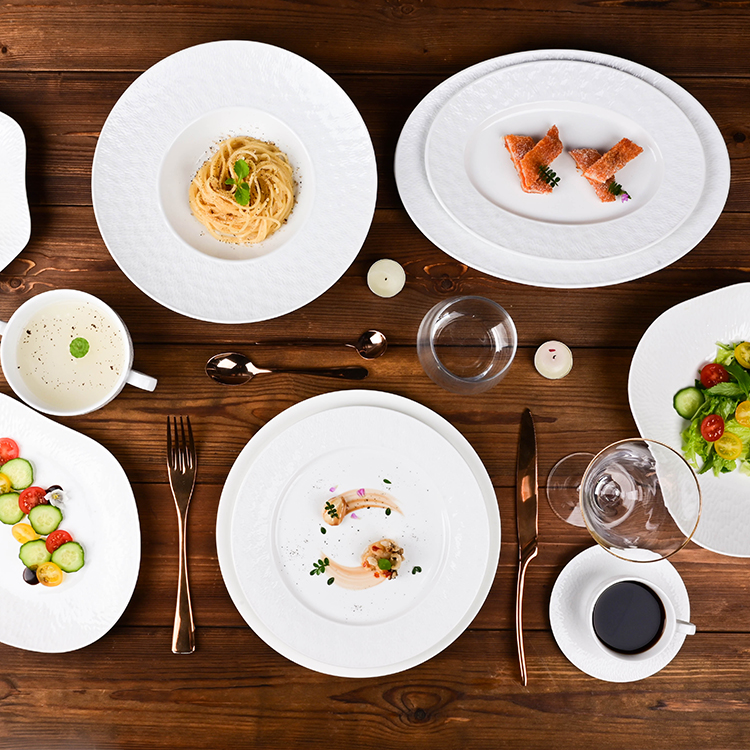
Flat dinner plates are the workhorse for composed Western dishes where chefs control layout across the plate. They suit roast dishes, poultry, seafood, and modern plated mains.
Size matters more than buyers expect. A small plate crowds the dish. An oversized plate makes a standard portion look weak. As a reference, casual Western mains sit well on a 10.5 to 12 inch (27 to 30 cm) flat plate. Fine dining rooms that rely on negative space may go to 12 to 13 inch (30 to 33 cm). Choose the size that makes the standard portion look intentional.
Coupe Plates: the Modern Workhorse
Coupe plates have a soft, rimless or low-rim profile. They suit modern Western restaurants, bistros, and hotel dining rooms that want a clean table setting. Chefs get a broad plating surface and a direct view of the food.
The usable surface is large relative to the diameter, so coupe plates adapt well to menus that change. They work for composed dishes, salads, shared plates, and some pasta dishes when the depth matches the sauce volume. For many bistros and modern dining rooms, a single coupe plate in two sizes can carry most of the menu.
Wide-Rim Plates: Use With Intention
Wide-rim plates create a defined frame around the food. They suit fine dining, hotel restaurants, and tasting menu service where presentation detail matters.
The rim gives the dish formal structure. It is also a trap. Buyers must check the usable center area, not the full diameter. A 12-inch wide-rim plate can offer a smaller plating area than a 10.5-inch flat plate. Across a full menu, wide-rim plates make portions look lost and raise per-cover plate cost. Use them where the presentation demands the frame.
Oval Plates: for Long and Irregular Cuts
Oval plates suit long or irregular foods: steak, whole fish, fillets, grilled meats, and shared dishes. The shape follows the length of the food better than a round plate.
Steakhouses and grill restaurants benefit from the extra cutting space. Fish dishes benefit from the length for garnish placement and sauce control. For most other menus, oval plates are a specialty item.
Deep Plates and Pasta Bowls: for Sauce-Based Dishes
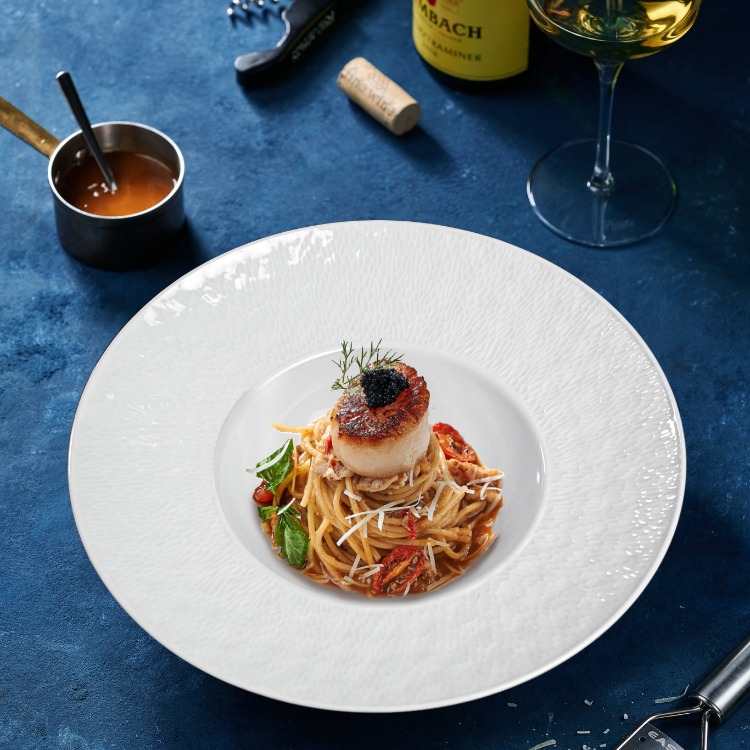
Pasta, risotto, stews, and sauced dishes need depth. A flat plate lets sauce spread too far. A narrow bowl hides ingredients. Deep plates and pasta bowls balance width and depth so chefs have visible space for ingredients, garnish, and sauce, and guests have depth to eat without spilling.
For pasta service, a plate with a 1.5 to 2.5 inch (4 to 6 cm) well and a wide flat rim performs well. The well holds the sauce. The rim gives chefs a place to rest garnish or cheese.
Treat Appetizer and Dessert Plates as a Separate Problem
Appetizer and dessert plates get treated as afterthoughts. Buyers specify them last and loosely. These are the plates where a Western restaurant shows the most character, because they carry smaller portions where every detail is visible.
Appetizer Plates: Focus and Speed
Appetizer plates support smaller portions, quick service, and clear focus. They make a small dish look complete without taking too much table space. Useful forms include small flat plates, coupe appetizer plates, rectangular plates, small bowls, and tasting plates.
A restaurant needs fewer appetizer plates than main course plates, so a bistro can afford a textured plate for a seasonal starter. A fine dining room can use a dedicated tasting plate for an amuse-bouche. Keep the range controlled: one or two standard appetizer plates, plus a specialty piece for a signature item. A useful size range is 7 to 9 inch (18 to 23 cm).
Dessert Plates: Contrast and Detail
Dessert plates need to highlight color, sauce work, garnish, height, and small details. A dessert portion is smaller than a main course, so the plate must create focus without making the portion look lost. Common forms include small round dessert plates, coupe dessert plates, wide-rim dessert plates, rectangular dessert plates, and small bowls for ice cream, mousse, fruit, or cream-based desserts.
Dessert plates can carry stronger contrast than the core collection. White plates help chocolate, fruit, and sauce colors stand out. Dark or color-glazed plates work for selected desserts when the color supports the dish. Heavy textures, irregular shapes, or strong glazes distract from precise pastry work. A typical dessert plate sits at 6 to 8 inch (15 to 20 cm).
Choose Materials by Positioning and Usage Level
Material choice matches the price level, service volume, and replacement expectations. A high-volume bistro and a luxury hotel restaurant need different plate solutions.
Fine Porcelain
Fine porcelain suits Western restaurants that need durability, low water absorption, and a clean appearance. It works well for high-volume Western restaurants, modern bistros, hotel restaurants, and any concept that needs a repeatable core plate collection. Fine porcelain designed for commercial use handles repeated washing, stacking, and service. Test samples in the restaurant’s own dishwashing and service environment before a bulk order.
Bone China
Bone china gives premium Western dining rooms a lighter, more refined table feel. It suits restaurants where the table setting supports guest experience and price positioning: fine dining restaurants, luxury hotel restaurants, executive lounges, premium Western concepts, and tasting menu service.
Before choosing bone china for the full plate collection, check handling, replacement cost, and service volume. Some restaurants use bone china for premium sections and fine porcelain for higher-volume service.
Royal White Porcelain
Royal white porcelain suits restaurants that need a clean, consistent, and flexible table setting. It works well for hotel dining rooms, banquet service, restaurant groups, and menus with seasonal changes. A stable white porcelain collection keeps presentation consistent while chefs adjust the menu.
Define a Color Strategy After Shape and Material
Color strategy affects presentation and replacement planning. Define the core plate color after shape and material are settled, then select accent pieces for specific dishes.
White Plates as the Core Collection
White porcelain plates remain the practical core choice for most Western restaurants. They support clean food presentation, menu flexibility, strong food-color contrast, and easier long-term replacement. White helps chefs evaluate color, sauce, and portion balance during menu development. For hotel restaurants and restaurant groups, a white base collection keeps table settings consistent across outlets.
There is a practical reason white works. Most Western food reads as warm color against a neutral background. Seared protein, red sauces, green vegetables, golden starches all pop harder on white under warm restaurant lighting. Food photography for menus is shot on white for the same reason.
Color Glazed or Textured Plates as Accent Pieces
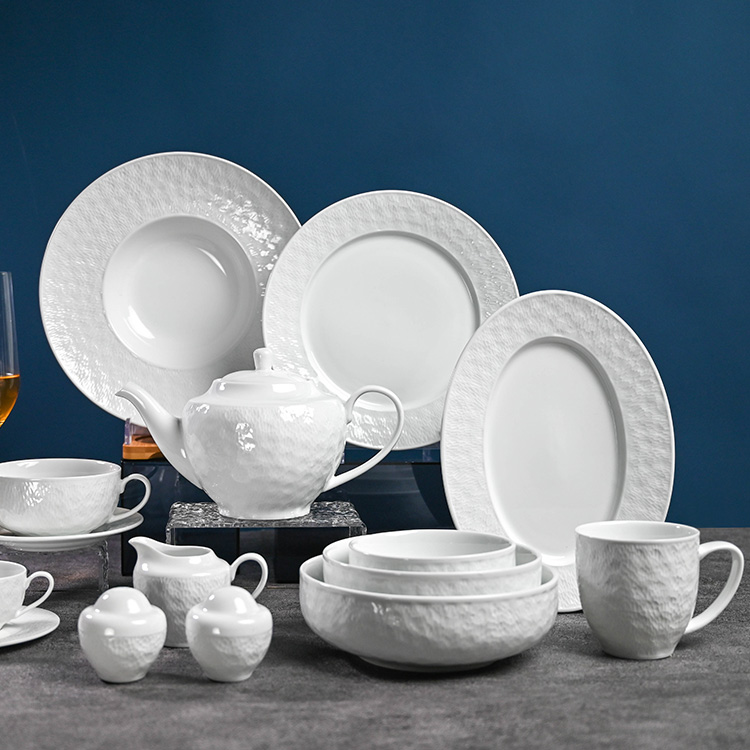
Color-glazed or textured plates can strengthen selected dishes. They work well for signature dishes, seasonal menus, rustic or modern bistro concepts, brand differentiation, social media presentation, and tasting menus.
Use accent pieces where they improve a dish. Avoid spreading colors and textures across the full menu. A distinctive plate becomes hard to replace, match, clean, or standardize. If it chips or wears differently from the core collection, the table starts to look inconsistent.
Build a stable white base collection for core service. Add selected accent pieces for signature dishes where the color earns its place.
Practical Plate Sets by Restaurant Type
Different Western restaurant formats need different plate systems. Start from the concept and define a minimal plate set that covers the menu.
Fine Dining Restaurant
Fine dining restaurants need precision on the plate. The set includes wide-rim or coupe main plates for controlled negative space, refined small plates for appetizers and amuse-bouche, dedicated dessert plates with contrast, and bone china or refined porcelain for premium table feel. Color stays restrained so attention stays on the food.
Hotel Western Restaurant
Hotel Western restaurants need flexibility. The same outlet may serve breakfast, lunch, dinner, room service, and event menus. The set includes a durable porcelain base collection in white, coordinated bowls, cups, saucers, and serving pieces, and stackable shapes for back-of-house efficiency. Hotel buyers should confirm the supplier can support repeat orders and banquet quantities.
Modern Bistro
Modern bistros need plates that feel current and hold up in service. A practical set is a coupe main plate, a deep plate or pasta bowl, one textured or matte accent plate for a signature dish, and a coupe plate in two sizes for appetizers and desserts. Bistros can use more character than formal hotel restaurants, but staff need plates they can wash, stack, and replace without trouble.
Steakhouse
Steakhouses need main course plates that support cutting, sauce, and high-value presentation. The set includes large flat plates and oval plates for steaks and grilled items, scratch-resistant surfaces, and stable weight with strong rims. Test knife contact, sauce movement, and plate stability before approving a bulk order. Darker accent pieces work when they suit the brand and the food color.
Café and Brunch Restaurant
Cafés and brunch restaurants need practical plates for frequent turnover, mixed menu items, and coordinated beverage service. The set includes breakfast plates, salad bowls, dessert plates, coupe or small flat plates for brunch items, and coordinated cups and saucers. Staff should know which plate belongs to pancakes, salads, sandwiches, desserts, and breakfast sets.
Test Plates With Real Dishes Before Bulk Ordering
Do not approve plates from catalog photos. Test samples with real menu items and real service conditions, organized into three checks.
Presentation check. Plate actual menu items and confirm portion appearance, sauce flow and sauce control, how food colors read on the plate, and how the dish looks under restaurant lighting.
Service check. Test cutting comfort for steak and grilled items, whether staff can carry the plate during peak hours, and whether the plate feels stable in a busy pass.
Operations check. Run full dishwasher cycles, test stacking and storage, and confirm replacement availability and MOQ before the bulk order.
A plate that looks suitable on a sample table can fail in service. Testing catches problems before the restaurant commits to plates for a full dining room, hotel outlet, or restaurant group.
Conclusion
Chefs use the plate as the frame for the dish. The right frame holds the food, the sauce, the knife, and the eye. It holds up through a full service, a hot dishwasher, and a reorder three years later.
Start with real dishes. Group the menu by serving need. Choose plate shapes that support portion size, sauce control, cutting comfort, and visual balance. Treat appetizer and dessert plates as a separate design problem. Lock material and color to brand positioning. Define a minimal plate set for the concept. Test samples under real restaurant conditions before placing a bulk order.
The plate is part of how the dish works.


LET'S TALK TOGETHER
Lorem ipsum dolor sit amet, consectetur estor adipi isicing elit, sed do eiusmod tempor este uterre incididui unt ut
