


PITO Article
How Chain Restaurants Can Standardize Tableware Across Multiple Locations
Chain restaurants do not buy tableware for one dining room. They build a tabletop system that must work across openings, replacements, franchise purchasing, regional teams, and replenishment cycles.
The risk is not choosing the wrong plate once. The larger risk is losing control after the brand expands. One branch uses a different bowl. Another branch replaces a broken plate with a local substitute. A franchisee orders a similar item with a different size or glaze. Six months later, the same dish looks different across locations.
Restaurant tableware standardization is the process of defining approved dinnerware items, commercial specifications, supplier rules, replacement procedures, and replenishment plans so every location can serve food with the same visual and operational standard.
For chain restaurant dinnerware projects, a usable standard answers four practical questions: what to buy, how to use it, how to replace it, and who can approve changes.
1. Define the brand dining experience before choosing tableware
Before selecting individual plates or bowls, define the dining experience the brand needs to repeat.
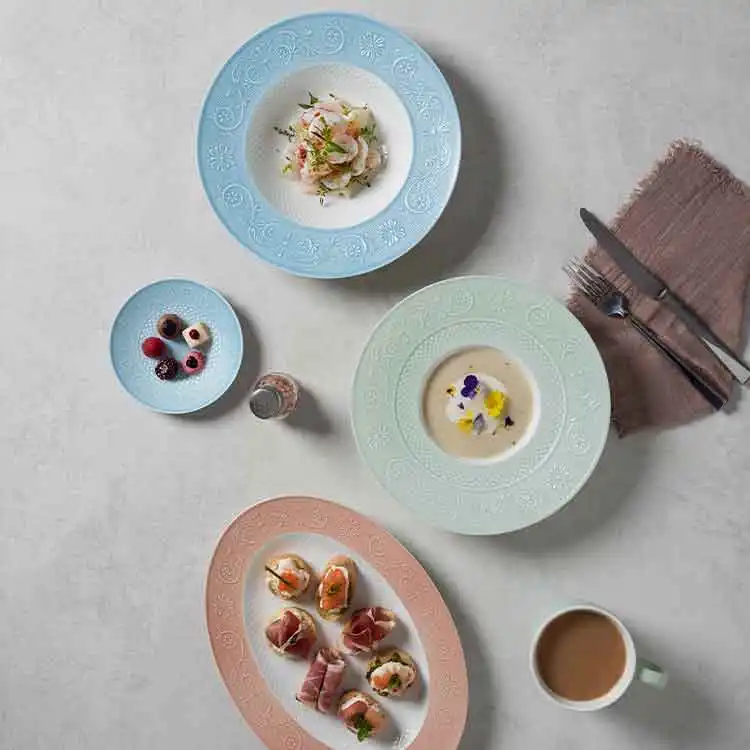
A fast casual brand may need durable porcelain tableware that supports quick plating and frequent dishwashing. A premium casual concept may need a more refined tabletop with controlled color, texture, and serving pieces. A café chain may care most about cup shape, logo placement, saucer fit, and drink presentation.
The brand standard should answer these questions:
- What should guests feel when they see the table?
- Which dishes define the brand visually?
- Should the tabletop feel modern, warm, handcrafted, minimal, colorful, or premium?
- Which pieces appear most often in store photos, delivery content, and social media?
- Which items must stay consistent in every location?
This step should stay close to the menu. A noodle chain may need deep bowls with controlled capacity and rim height. A steakhouse group may need plates that support sauce control, steak knives, and premium plating. A café may need cups that keep latte art, logo visibility, and saucer fit consistent across stores.
A chain restaurant should standardize more than the product list. It should standardize the visual language of the table.
2. Build a clear tableware specification before purchasing
Chain restaurant buyers should not rely on product names alone. Two suppliers may both offer a “10-inch white plate,” but the rim width, glaze tone, weight, curve, stacking height, and food presentation may differ.
Small differences can affect plating, replacement consistency, storage, dish rack fit, and branch-level purchasing. For multi-location restaurant procurement, a written specification is the control point between headquarters, franchisees, project buyers, warehouse teams, and suppliers.
| Specification item | Why it matters |
| Item name and product code | Prevents wrong reorders and local substitutions |
| Material | Affects durability, weight, appearance, and cost |
| Diameter, length, width, height | Controls plating space, storage, and equipment fit |
| Bowl or cup capacity | Supports portion control and beverage consistency |
| Weight range | Helps control handling comfort and batch consistency |
| Color and glaze reference | Reduces visual mismatch across repeat orders |
| Finish type | Affects appearance, cleaning, and service use |
| Logo or decoration position | Controls brand presentation and food-contact review |
| Dishwasher or microwave suitability | Supports store-level operating procedures |
| Stackability | Affects storage, washing, staff handling, and breakage |
| Packing method | Affects shipping, warehouse handling, and branch distribution |
| Approved supplier | Keeps purchasing within the approved supply system |
| Approved replacement item | Prevents uncontrolled substitutions when stock changes |
Commercial dinnerware specifications should be clear enough for a new buyer, a franchisee, or a warehouse team to place the correct order without guessing.
For custom colors, shapes, or logo decoration, the approved sample should be archived and used as the reference for future production, inspection, and repeat orders. Without that reference, a supplier discussion can turn into a subjective debate about whether the new batch is “close enough.”
3. Control SKUs to simplify purchasing and replacement
Too many tableware SKUs create operational problems. A large product list may look flexible during menu development, but it can make daily purchasing harder.
SKU complexity can lead to:
- warehouse confusion
- wrong reorders
- inconsistent branch substitutions
- higher replacement costs
- staff confusion during service
- slower franchise approval
- poor visibility into breakage and consumption
A chain brand should build the core range first, then add special items later.
A practical core range may include:
- main dinner plate
- side plate
- deep plate or pasta plate
- main bowl
- small bowl
- sharing platter
- sauce dish
- cup or mug
- saucer if needed
- selected serving pieces for signature dishes
For stronger control, headquarters can separate tableware into three groups: required core SKUs, optional service SKUs, and limited-use seasonal or promotional SKUs. Core SKUs need long-term replenishment control. Seasonal pieces need a clear exit plan so they do not remain in warehouse inventory after the campaign ends.
Special items should have a clear role. They may support a signature dish, seasonal campaign, flagship store, or premium menu category. If a piece does not improve service, presentation, or brand value, it may add more complexity than value.
The goal is not to reduce the dining experience. The goal is to reduce uncontrolled variation.
4. Test tableware with real menu items and real service conditions
Tableware cannot match only the interior design. It must match the menu and the service process.
A plate may look attractive in a showroom but fail during peak service. A bowl may photograph well but hold the wrong portion. A wide rim may improve presentation but slow down plating. A tall stack may not fit the dish rack or storage shelf.
Before approval, test tableware with real menu items and real operating conditions:
- portion control
- sauce behavior
- stackability
- dish rack compatibility
- tray and counter fit
- rim handling safety
- bowl volume accuracy
- visual presentation for signature dishes
- cleaning and drying after commercial washing
During pilot testing, teams should record plating feedback, breakage observations, dishwashing results, stacking issues, and staff comments by SKU. These records help procurement teams approve or reject items based on operating evidence, not showroom appearance.
This step protects both guest experience and back-of-house efficiency. A standardized restaurant tableware system should help staff serve the same food in the same way across locations.
5. Choose materials for repeated commercial use
Restaurant dinnerware faces harder use than household dinnerware. Chain restaurants add another layer of pressure because the same item may be used and washed across many branches every day.
Material choice should reflect the service model.
Porcelain tableware for chain restaurants can balance durability, cost control, production consistency, and a clean dining presentation. Bone china may suit premium concepts, VIP dining, or selected service pieces. Stoneware and reactive glaze items can support casual or lifestyle brands, but buyers should review color variation, chip resistance, weight, and long-term replenishment risk.
Porcelain is often selected for chain restaurant dinnerware because it can offer a clean appearance, stable production, and compatibility with many restaurant concepts. It still needs testing. Buyers should check edge strength, glaze durability, weight, stacking performance, commercial dishwasher results, and whether the item remains practical during peak service.
When comparing materials, buyers should consider:
- service frequency
- edge strength
- glaze durability
- stacking pressure
- commercial dishwashing
- thermal shock risk
- handling weight
- replacement cost
- brand positioning
A cheaper plate can become expensive if it increases breakage, emergency replacement, or visual inconsistency across stores. The better comparison is not only unit price. It is total cost across purchase, shipping, storage, breakage, replacement, compliance review, and store opening risk.
6. Standardize color, glaze, logo, and decoration details
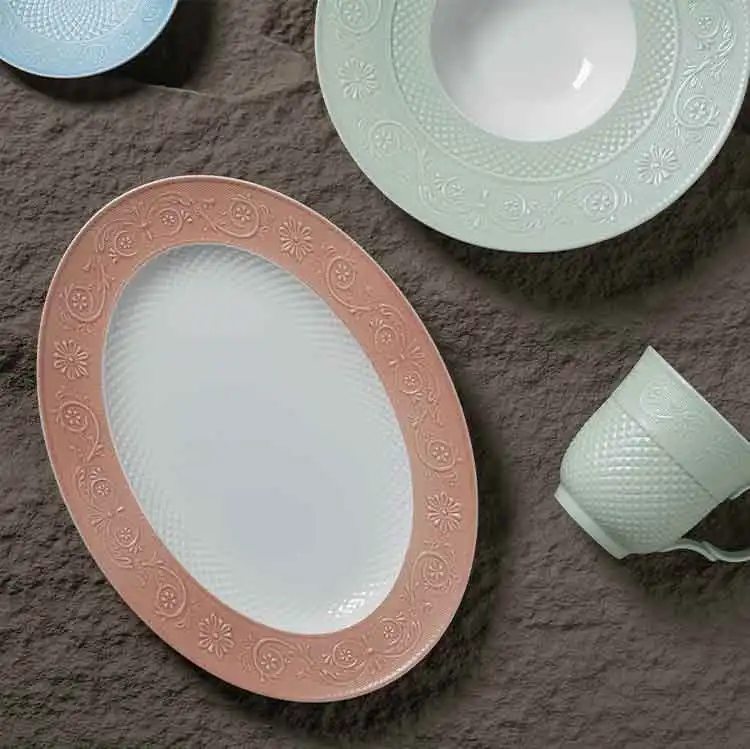
Color and decoration are part of the specification, not afterthoughts.
A slight color difference may be acceptable in one restaurant. Across many branches and repeat orders, that difference becomes visible. Old and new pieces may appear on the same table. Franchisees may compare samples against local substitutes. Guests may notice that the same dish looks different from one location to another.
Buyers should define:
- approved color range
- approved glaze sample
- surface finish
- logo size and position
- decoration method
- acceptable production tolerance
- whether handmade variation is allowed
- whether reactive glaze variation fits the brand
Custom restaurant tableware supplier discussions should include decoration limits early. Logos, decals, metallic rims, colored glazes, and decoration near the food-contact surface may affect durability, usage instructions, microwave suitability, or compliance review.
The approved sample should remain available to procurement, quality control, and the supplier. It gives every team a shared reference when reviewing future production or replacement items.
7. Plan replenishment before the first order
A tableware program fails when a chain can open beautifully but cannot replace the same plate six months later. Breakage, loss, new store openings, menu updates, and seasonal demand all require repeat supply.
Before the first order, buyers should confirm:
- repeat-order MOQ
- repeat-order lead time
- mold availability
- glaze formula and color records
- archived custom decal or logo files
- safety stock plan
- approved substitution rules
- who approves replacements
- whether phased delivery is available
- whether packaging can support branch distribution
Restaurant dinnerware replenishment should be part of the first procurement discussion. This matters even more for custom logo tableware, custom colors, and pieces made for a specific restaurant group.
A practical replenishment plan should consider opening stock, expected breakage, safety stock, new store rollout schedules, supplier lead time, and shipping time. For custom items, buyers should confirm whether molds, glaze records, logo files, and approved samples can be maintained for future orders.
A chain brand should also track branch-level breakage. High breakage in one item may point to a design problem, handling problem, dishwashing issue, or poor fit with the service model. Tracking breakage by SKU and location helps headquarters distinguish between a product issue, a training issue, and a replenishment planning issue.
If a chain is planning new openings, PITO can review the SKU list, estimated location count, and replenishment expectations before production planning begins.
8. Create purchasing rules for franchisees and regional teams
Franchisees and regional teams need clear rules. Without rules, each branch may solve replacement problems locally. That is how a brand loses control of tabletop consistency.
Headquarters should provide:
- approved tableware catalog
- required SKU list
- optional SKU list
- opening kit list
- approved supplier list
- reorder process
- approved substitute rules
- photo references
- quality inspection criteria
- local substitution approval process
The purchasing guide should also state what franchisees cannot change without approval, such as plate size, glaze color, logo position, supplier, material, and substitute SKU.
The right process should make the approved item easier to buy than the wrong substitute. If headquarters cannot provide stable replenishment, local replacement becomes likely, especially in overseas markets.
For overseas franchises or regional rollouts, the purchasing rules should also address shipping time, customs documents, food-contact documentation, and local storage. A tableware standard only works if stores can follow it under real purchasing conditions.
9. Pilot test tableware before full rollout
A chain restaurant should not approve a full rollout from catalog photos. Samples need to enter a real store or test kitchen before the brand commits to large-volume purchasing.
A useful pilot test can include:
- culinary team review
- operations team review
- procurement review
- plating tests with actual menu items
- peak-service handling tests
- stacking and storage tests
- dishwasher tests
- breakage observation
- staff feedback
- food-contact documentation review for target markets
At the end of the pilot, each SKU should have a clear decision: approved, revised, replaced, limited to selected locations, or removed from the program. This prevents weak items from entering the full rollout by default.
Pilot testing helps the brand catch small problems before they become expensive. Once the same item is rolled out to many locations, changing it becomes harder and more costly.
10. Review food-contact compliance for target markets
Compliance should enter the procurement process before production, especially when the same collection may be used in more than one country.
Different markets may require different food-contact documentation. A collection used in the United States, Europe, the Middle East, or Asia may need separate review based on destination market, material, glaze, decoration, and food-contact surface.
For ceramic, porcelain, and bone china tableware, buyers should pay close attention to:
- lead release
- cadmium release
- glaze safety
- decoration position
- logo or decal placement
- whether the report matches the exact item, color, glaze, and decoration
- whether the same collection will be used across several markets
FDA-related requirements for ceramicware in the U.S. include extractable lead and cadmium enforcement considerations. The EU has separate rules for ceramic articles intended to contact food, including migration limits and documentation requirements. Other markets may also set limits or documentation expectations for heavy metal migration from ceramic foodware. For example, Singapore’s food safety authority requires imported, sold, and used foodware to comply with food regulations and controls risks such as heavy metal migration.
Buyers do not need to turn every purchase discussion into a legal review. They do need item-specific test reports and documentation that match the actual product. A general material certificate is not enough if the order includes a different glaze, color, logo, decal, or decoration position.
Compliance should be checked against the actual decoration position, not only the ceramic body. A logo on a cup exterior is different from decoration near the rim or inside a bowl.
11. Work with a supplier that can support system-level purchasing
For chain restaurant brands, the supplier’s role should go beyond selling available plates and bowls. Multi-location projects need a partner that can support specifications, samples, production records, packaging, repeat orders, and documentation.
When choosing a supplier, buyers should review whether the supplier can support:
- HORECA and restaurant group projects
- commercial dinnerware specifications
- custom shape or logo development
- approved sample control
- item-level production records
- consistent bulk production
- batch inspection
- SKU-based carton labeling
- export packaging
- repeat-order planning
- replacement item planning
- phased delivery for new openings
- food-contact documentation by target market
- communication with procurement, design, and operations teams
For chain restaurant brands, the right tableware supplier should act like a rollout partner, not just a product vendor. The supplier should help the buyer keep approved specifications stable across first orders, repeat orders, new stores, and regional expansion.
12. How PITO supports chain restaurant tableware programs
PITO supports hospitality, restaurant, distributor, private-label, and chain-brand buyers with porcelain, bone china, and professional ceramic tableware projects. For chain restaurant dinnerware projects, PITO can help buyers turn menu requirements, brand standards, and rollout schedules into a standardized restaurant tableware system.
Standard development
PITO can help buyers organize material selection, shape direction, size range, capacity, color and glaze references, logo placement, packing method, SKU structure, and approved replacement rules before mass production.
This stage helps turn a tabletop concept into a purchasing specification that headquarters, franchisees, warehouse teams, and suppliers can follow.
Custom porcelain and ceramic development
For chain brands that need custom restaurant tableware, PITO can support discussions around porcelain, bone china, glaze direction, logo decoration, sample confirmation, and production feasibility.
The goal is to confirm whether the design works not only as a sample, but also as a repeatable product for store openings and later replenishment.
Repeatable production
Chain restaurant projects need more than attractive samples. They need controlled production records, approved samples, batch consistency, carton labeling, packing requirements, and replenishment planning.
PITO can support discussions around sample confirmation, custom logo files, production details, packing requirements, and repeat orders based on the buyer’s project needs.
Expansion support
For brands opening multiple locations or entering new markets, tableware supply must match the rollout plan. Buyers may need phased delivery, export packaging, carton labeling, documentation support, and coordination for future replenishment.
Before contacting PITO, buyers can prepare:
- restaurant concept
- menu type
- number of current and planned locations
- target markets
- preferred material
- logo or color requirements
- estimated opening schedule
- replenishment expectations
- budget range if available
These details help the supplier recommend a more practical tableware system instead of quoting isolated products.
Practical checklist for chain restaurant tableware standardization
Use this checklist before approving a multi-location tableware program:
- Define the brand dining experience.
- Map tableware to menu categories and portion standards.
- Build a master specification sheet.
- Assign product codes for all approved items.
- Control SKUs before adding special pieces.
- Test items with real menu items and service conditions.
- Confirm material suitability for commercial use.
- Standardize color, glaze, logo, and decoration details.
- Confirm repeat-order MOQ and lead time.
- Archive molds, glaze records, and logo files where relevant.
- Define safety stock and approved substitution rules.
- Create franchise and regional purchasing rules.
- Pilot test before full rollout.
- Review food-contact documentation for target markets.
- Work with a supplier that can support samples, bulk production, packaging, and replenishment.
Buyers can use this checklist as an internal preparation tool before requesting a quotation from PITO or another custom restaurant tableware supplier.
To request a more accurate quotation, prepare the following information:
- target number of locations
- opening schedule
- estimated quantity by SKU
- preferred material
- logo or color requirements
- target market
- required documents
- replenishment expectations
Conclusion
For a single restaurant, tableware can be a design choice. For a chain restaurant brand, it becomes part of the operating system.
A controlled tableware program helps the brand keep food presentation consistent, simplify purchasing, reduce replacement confusion, support franchise execution, and plan long-term supply. It also gives procurement teams a clearer way to manage cost, quality, documentation, and supplier responsibility.
The strongest chain restaurant tableware programs are not built from random catalog selections. They are built from clear specifications, real menu testing, SKU control, replenishment planning, and suppliers that can repeat production as the brand expands.
If your team is planning restaurant tableware standardization across multiple locations, send PITO your menu structure, target number of locations, preferred materials, logo requirements, target markets, rollout schedule, and replenishment needs. The team can help review the project and support a practical chain restaurant dinnerware specification before production begins.


LET'S TALK TOGETHER
Lorem ipsum dolor sit amet, consectetur estor adipi isicing elit, sed do eiusmod tempor este uterre incididui unt ut
