




PITO Article
Hotel Tableware Breakage Cost: The Hidden F&B Profit Leak
Hotel F&B margins are thin, and everyone watches the big numbers: food cost, labor, energy. But there’s a cost most hotels never pull out of the general ledger. Plates break. You order more. Year after year.
The industry default for annual breakage is 8% to 12%. That number is high enough to be a problem, but it’s rarely questioned. Put it in dollar terms: a 300-room hotel can burn through $50,000 to $60,000 a year on broken plates alone — not counting labor, not counting the inventory you’re holding just in case, not counting the servers who can’t keep up because the plates weigh too much. When you add it all up, your tableware is quietly eating 5% to 15% of your F&B profit.
I’ve been making ceramics at PITO for close to twenty years. We don’t judge a plate by how it looks. We look at firing temperature, water absorption, and breaking strength. A plate fired at 1320°C and one fired at 1200°C are not the same product — the physics are different. I’ll walk through the details below, but the short version is this: plate breakage is not bad luck. It’s bad material.
This article breaks down every hidden cost of substandard tableware and explains what you should be looking for — if you’re the person signing the purchase order — to stop the leak.
Note: The data and formulas in this article are based on PITO lab testing and nearly 20 years of customer usage data. Results will vary by brand and usage scenario, but the magnitudes are correct.
What Broken Plates Actually Cost
Most procurement teams look at the invoice price. $4 a plate, done. The real cost is significantly higher.
What’s a normal breakage rate?
It depends entirely on what the plate is made of.
Ceramics fired at 1100°C–1200°C are porous. There are microscopic voids in the body that fill with moisture. When a commercial dishwasher hits them with 85°C water, that moisture expands instantly and the plate cracks. These plates break at 8% to 12% per year. That’s normal for that material.
High-fired fully vitrified porcelain fired at 1320°C doesn’t have this problem. At that temperature, quartz and feldspar fully melt and fuse into a glass-like structure, forming a highly dense porcelain body. This structure fundamentally prevents moisture penetration, resulting in ultra-low water absorption (under 0.5%), outstanding thermal shock resistance, and superior chip resistance, ensuring a significantly longer lifespan. These plates break at only 1.5% to 2.5% per year.
If your banquet hall replaces 10% of its plates every year, the fix isn’t a new supplier. It’s a new material.
How to calculate your real monthly replacement cost
The invoice price is the smallest part. A broken plate means someone sweeps it up, someone unboxes a replacement, someone washes and shelves it. And you’re carrying 15% to 20% extra inventory year-round just to avoid running out during service.
The real formula: (Monthly covers × Breakage rate × Unit cost) + (Labor to process replacements) + (Inventory carrying cost)
Here’s a real example. A 300-room hotel serving 15,000 covers a month, with 8% breakage on $4 plates. Direct replacement: $4,800/month, or $57,600/year. Add 15% for labor and inventory overhead, and you’re over $66,000 a year. For one category. Plates.
Heavy plates cost you money too
Breakage is half the problem. The other half is in your servers’ arms.
Standard stoneware and budget porcelain dinner plates weigh 850g to 1,200g each. A tray with six plates is 5–7 kg. Over a six-hour shift, a server lifts that weight a hundred times. What happens? They slow down, their arms hurt, and when fatigue sets in, more plates hit the floor.
If you engineer plates down to 550g–650g — possible by achieving high-density vitrification with high-fired porcelain — the tray weight drops by about 40%. That 40% is directly measurable: faster service, fewer dropped trays, and during peak breakfast hours, faster table turns.
This isn’t a guess. Across hotels we’ve worked with, reducing plate weight by 40% led to a measurable improvement in breakfast turn time — roughly 3 to 5 minutes per table. On a full house morning, those minutes are an extra turn.
Cost comparison at a glance
| Cost component | Budget ceramic (1200°C) | PITO 1320°C high-fired fully vitrified porcelain | Annual savings (per 100 covers/day) |
|---|---|---|---|
| Breakage rate | 8–12% | ≤2.5% | 75% fewer replacements |
| Weight (dinner plate) | 850–1,200g | 550–650g | 40% lighter |
| Replacement frequency | 6–9 months | 18–24 months | Procurement admin cut in half |
| Annual cost per 100 covers | $4,200 – $5,500 | $1,100 – $1,400 | ~$3,500+ saved per outlet |
Three Things to Look at When You Buy Plates
Most hotel buyers I talk to look at three things: price, color, and whether they stack. That’s not wrong, but if you’re optimizing for five-year total cost rather than lowest invoice, you need to look at three other things: firing temperature (how long they last), weight (how your staff handles them), and appearance (what the guest thinks your food is worth).
Firing temperature is everything
How long commercial tableware lasts depends on what happened in the kiln.
At 1320°C, kaolin and feldspar undergo a complete chemical reaction. Quartz dissolves into a glassy matrix, needle-like mullite crystals interlock, and the whole structure fuses into a rigid whole. That’s full vitrification, the core characteristic of premium high-fired porcelain. At 1200°C, the same raw materials don’t fully react. Particles stay un-melted. Voids remain.
The practical difference: high-fired fully vitrified porcelain absorbs less than 0.5% water. Coffee, curry, and dishwasher chemicals stay on the surface. Thermal shock from a 90°C washer to a 4°C walk-in doesn’t crack it. Budget ceramic absorbs 3%–7%. Stains seep in over months. Odors develop. And the thermal shock of a commercial dishwasher cycle eventually shatters it.
You don’t need a lab. When samples arrive, take a permanent marker and draw a line on the unglazed foot ring. Wipe it off. If it comes clean, the body is dense. If the mark stains the ring, the ceramic is porous and will harbor bacteria and odors in a commercial kitchen. Reject it.
Light doesn’t mean weak
There’s a persistent assumption that heavy plates are durable plates. In ceramics, it’s the opposite.
Bone china is 30% to 40% lighter than standard porcelain. The bone ash (30%–45% calcium phosphate) lowers the melting point and increases structural density. The result: a plate that’s light in the hand, rings with a clear note when tapped, and resists chipping better than most budget ceramics. For multi-course fine dining, that lightness means servers don’t get fatigued by the fifth course.
The same logic applies to high-fired porcelain. A well-formulated clay body fired at 1320°C achieves a truly high-density structure. It is this dense physical property that allows the plate to reach the same breaking strength as heavy stoneware at nearly half the weight. You’re paying for density, not mass.
The operational impact is real. 30% to 40% lighter plates mean servers move faster, carry more, and drop less. During peak breakfast, that’s faster turns and fewer temp hires.
Plates are your restaurant’s face
This isn’t marketing. The guest starts forming opinions the moment they sit down. A plate that looks dull, has a thick rim, or shows uneven glaze — those are “cheap” signals. The guest probably won’t articulate it, but they’ll feel the meal isn’t worth the price.
A bright white, translucent dinner plate with clean lines makes food look better with zero extra effort from the kitchen. That’s why high-end restaurants spend more on tableware. It’s not vanity. It’s ROI: better presentation justifies higher menu prices, and better-looking plates end up on social media.
None of this matters if the plate isn’t safe. FDA, LFGB, and SGS certifications confirm the glaze contains no leachable lead or cadmium. Cutting corners here will cost more than any broken plate ever could.
The three materials side by side
| Dimension | Metric | Budget ceramic | PITO high-fired fully vitrified porcelain | PITO bone china |
|---|---|---|---|---|
| Material | Firing temp | 1100–1200°C | 1320°C | 1280°C |
| Water absorption | 3–7% | <0.5% | <0.5% | |
| Efficiency | Weight (dinner plate) | 900–1,200g | 600–700g | 450–550g |
| Chip resistance | Low | High | Very high | |
| Appearance | Visual quality | Opaque, dull | Bright white | Translucent |
| Best for | Staff cafeteria | Banquet, buffet | Fine dining, executive lounge |
Bone China vs. Vitrified Porcelain: Match the Material to the Outlet
A mistake I see often: standardizing one plate material across every outlet to simplify procurement. It sounds efficient. It costs money.
Fine dining and ballrooms have nothing in common. A plate engineered for a banquet hall — thick rim, heavy weight, built to stack high — is completely wrong for a tasting menu where presentation matters.
When to use bone china
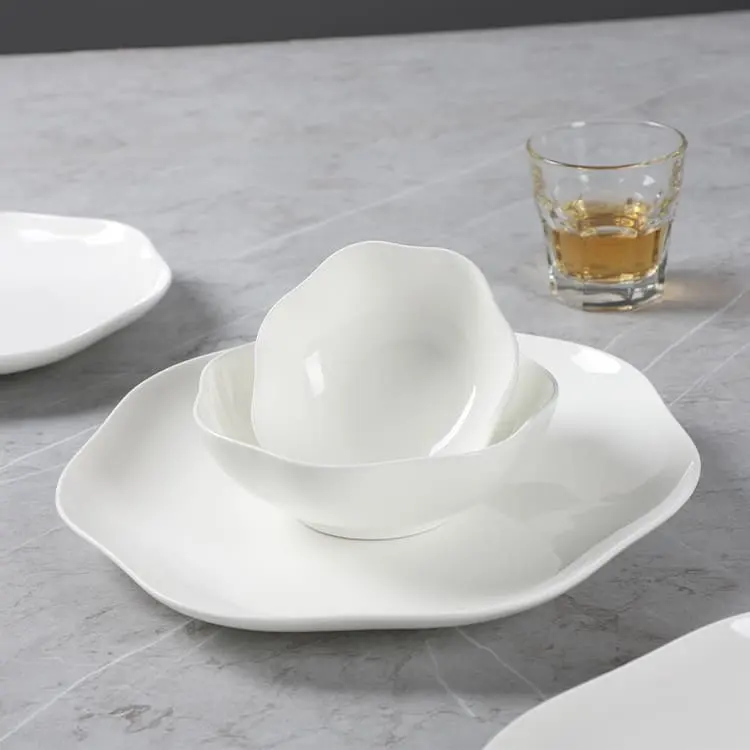
Bone china is the best physical performer in ceramics. High bone ash content (30%–45%) produces translucency, a clear ring when tapped, and genuine lightness.
Use it for Michelin-level restaurants, executive lounges, VIP dining rooms, and afternoon tea. These outlets run multi-course service where server fatigue is real — by the fifth course, a heavy plate in a tired hand means sauce on the tablecloth. Bone china solves that. And the aesthetics are not secondary: food on a translucent white plate needs no filter. Higher plating quality means higher menu prices, and the plate pays for itself.
When to use high-fired fully vitrified porcelain
High-fired fully vitrified porcelain is the workhorse. It’s for environments where plates get stacked high, turned fast, and knocked around: ballrooms, breakfast buffets, all-day dining, and conference centers.
Its strength is thermal shock resistance and the superior chip resistance provided by its dense body. Heat lamp for hours, then straight into a 90°C dishwasher — no cracking. Budget ceramic won’t survive that cycle for six months.
The economics flip when you look at five-year cost. Lower breakage means the per-plate lifetime cost of high-fired porcelain is actually lower than budget ceramic, despite the higher unit price. You pay more once, you pay less for years.
Zone your procurement by outlet
Don’t buy one material for the whole hotel. Buy bone china for the signature restaurant. Buy 1320°C high-fired fully vitrified porcelain for the ballroom and buffet. Buy stoneware or melamine for poolside. Let each material do what it does best.
| Hotel outlet | Recommended material | Why | Expected breakage |
|---|---|---|---|
| Fine dining | Bone china | Light, elegant, multi-course friendly | 1.5–2% |
| Banquet hall | 1320°C high-fired fully vitrified porcelain | Durable, stackable, dense body, low cost per cover | 2–3% |
| Breakfast buffet | 1320°C high-fired fully vitrified porcelain | Thermal shock resistant, highly chip resistant | 2.5–3.5% |
| All-day dining | Reinforced porcelain | Balanced durability and appearance | 3–4% |
| Poolside/outdoor | Stoneware or melamine | Impact resistant, casual styling | 4–6% |
What to Ask Your Supplier
Skip the catalog. Every factory’s product photos look the same. What you need are numbers.
Firing temperature and water absorption
Ask directly: What’s your firing temperature? What’s your water absorption rate?
If they say “our plates are very durable” but fire at 1220°C, the physics don’t support the claim. True vitrification and the formation of a dense structure require temperatures above 1280°C. Anything below that will absorb 2% or more water and will fail in a commercial dishwasher within months.
When samples arrive, do this: draw a line on the unglazed foot ring with a permanent marker or strong coffee, then wipe. Clean wipe = dense body, low absorption. Stained ring = porous ceramic that will harbor bacteria and odors. Reject it. No lab needed, takes 60 seconds.
Certifications matter
International hotel brands audit tableware. Have these ready:
- FDA (US market) or LFGB (Europe): confirms zero leachable lead and cadmium in the glaze.
- SGS or Intertek third-party test reports: heavy metal release, material composition, and thermal shock endurance.
- BSCI or Sedex factory audit: ethical manufacturing verification.
Insist on batch-specific reports, not “we tested once three years ago.” Each shipment should come with current data.
Customization
If you need branded tableware — logo decals, custom shapes, rim bands — ask about timeline and minimums. Mold development lead time, MOQ, and Pantone matching precision (ΔE value). A real manufacturer answers these directly. A trading company says “I’ll check with the factory.”
Technical specs at a glance
| Spec | Industry typical (budget) | PITO standard | Why it matters |
|---|---|---|---|
| Firing temperature | 1100–1250°C | 1320°C (High-fired) | Determines full vitrification & body density |
| Water absorption | 1–3% | <0.5% | Stain resistance, no odor |
| Breaking strength | 15–20 MPa | ≥25 MPa | Survives stacking and handling |
| Thermal shock resistance | ±80°C | ±120°C | Dishwasher + heat lamp safe |
| Lead/cadmium | Meets basic FDA | Undetectable | Guest safety |
| Dishwasher cycles | 2,000–3,000 | 5,000+ | Longer lifespan, lower lifetime cost |
What PITO Does
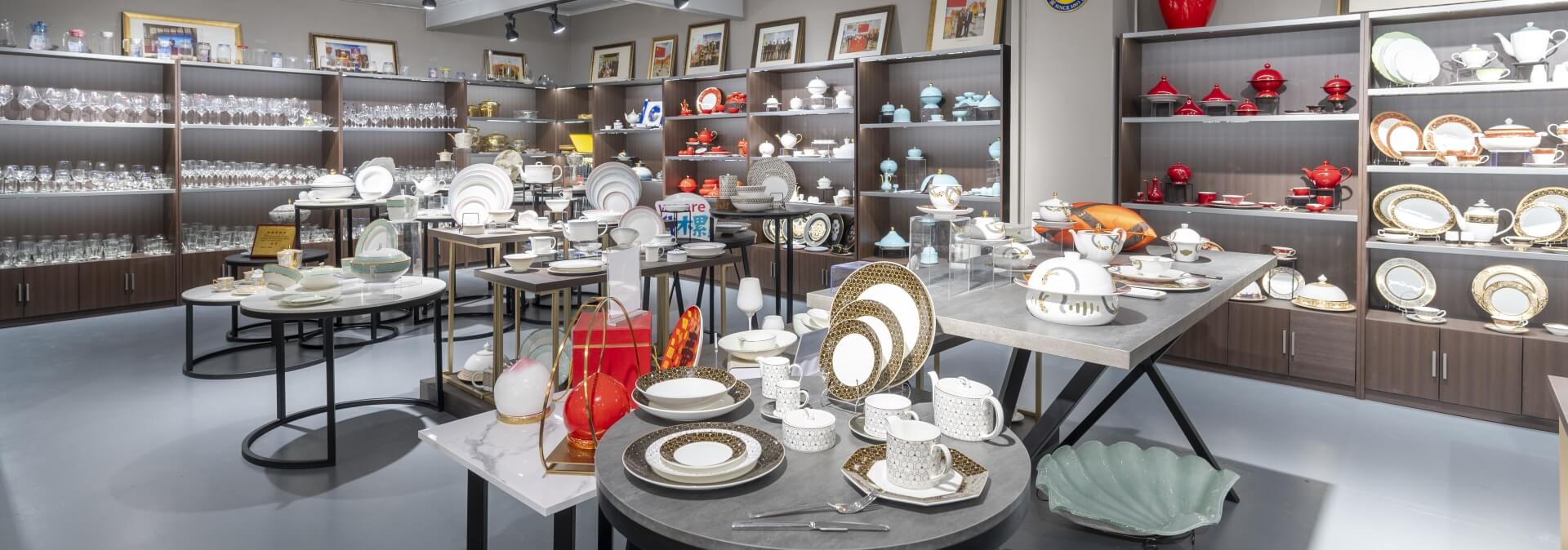
We’ve been making ceramics in Chaozhou, Guangdong for close to twenty years. Two main product lines: 1320°C high-fired fully vitrified porcelain and premium bone china. Our customers are international hotel groups, importers, and restaurant chains.
We also supply glassware, cutlery, and hotel linens — not because we’re trying to be everything, but because hotel buyers kept asking. It’s more efficient to consolidate: one supplier, one color standard, one window for reorders.
Customization process
If you need branded tableware, it’s four steps:
- Scope: how many outlets, what type, what budget, logo or not, timeline.
- Design and prototype: mold development, glaze matching, physical samples for chef and design team review.
- Production and QC: 13 inline inspection points, from raw clay through firing and packaging, ensuring every piece has a stable, uniform dense structure.
- Shipping and after-sales: export packing, container optimization, dedicated account manager for reorders.
Breakage guarantee
We guarantee our 1320°C high-fired fully vitrified porcelain lines at ≤2.5% annual breakage under normal commercial use. If material failure pushes you past that, our after-sales team works directly with your stewarding department. This isn’t marketing language — twenty years of customer data backs it up.
One Last Thing
Tableware is not a consumable — even if most hotel procurement processes treat it like one. You source produce by origin, freshness, and price. For plates, most buyers check one thing: “how much each, and can you deliver?”
But plates aren’t produce. Produce is gone in a day. A dinner plate serves hundreds of covers, goes through thousands of dishwasher cycles, gets stacked and unstacked thousands of times, and has knives dragged across it by hundreds of guests. Over years.
The wrong material taxes your P&L every day. The right material saves you money — not because it was cheaper to buy, but because it lasted long enough for the unit economics to make sense.
If you’re thinking about switching suppliers or materials, get in touch. Send your current breakage data and outlet types. I’ll run the numbers on what switching to 1320°C high-fired fully vitrified porcelain or bone china saves over five years. No charge. Just math.
Frequently Asked Questions (FAQ)
1. What’s a normal breakage rate for hotel plates?
1.5%–2.5% annually for 1320°C high-fired fully vitrified porcelain. Budget ceramics fired at 1100°C–1200°C typically break at 8%–12%. If you’re replacing 10% of your banquet plates every year, the fix isn’t a better supplier — it’s a different material.
2. How often should hotels replace dinnerware?
Budget ceramic in banquets and buffets needs major replacement every 6–9 months. High-fired porcelain fired at 1320°C stretches to 18–24 months. Bone china in fine dining, with proper handling, lasts 3 to 5 years.
3. How do I calculate my monthly replacement cost?
Formula: (Monthly covers × Breakage rate × Unit cost) + Labor + Inventory overhead. Real example: 10,000 covers/month, 5% breakage, $3/plate = $1,500/month just in direct plate cost. That’s $18,000/year before labor.
4. Is bone china durable enough for commercial use?
Good bone china — 30%–45% bone ash, fired above 1280°C — is highly chip resistant and 30%–40% lighter than standard porcelain. For fine dining, executive lounges, and VIP service, it’s more than sufficient. Bad bone china — low ash content, low firing temp — is a different product. That’s “new bone china,” not real bone china.
5. What certifications do hotel plates need?
Minimum: FDA (US) or LFGB (Europe) for lead and cadmium. Ideally: SGS third-party test reports (including water absorption and thermal shock tests) and BSCI factory audit. Batch-specific, not a three-year-old certificate in a drawer.
6. Are lightweight plates still durable?
Yes. In ceramics, density equals strength, not weight. Bone china is 30%–40% lighter than standard porcelain with comparable breaking strength. High-fired fully vitrified porcelain at 600g–700g achieves the same structural performance as stoneware at 1,200g. Weight is not a virtue — it typically means the firing wasn’t hot enough.
7. What’s the difference between 1200°C and 1320°C firing?
1320°C is full vitrification: water absorption under 0.5%, glass-like density, stain resistant, thermal shock resistant. 1200°C is semi-vitrified: 2%–4% absorption, porous, stains easily, cracks under dishwasher thermal shock. The difference isn’t 120 degrees — it’s whether your plates last six months or two years.


LET'S TALK TOGETHER
Lorem ipsum dolor sit amet, consectetur estor adipi isicing elit, sed do eiusmod tempor este uterre incididui unt ut
