


PITO Article
Vitrified Porcelain Plates: Why They Resist Chipping
A plate comes back from the kitchen with a chipped rim. The cost is more than one broken piece. You must reset the place setting, find a match, and a guest may notice the gap.
Buyers who choose vitrified porcelain plates are trying to avoid this. “Vitrified” is not a sales word. It names a real state of the ceramic body, and it is the main reason this plate lasts in daily restaurant and hotel use.
What does “vitrified” mean on a porcelain plate?
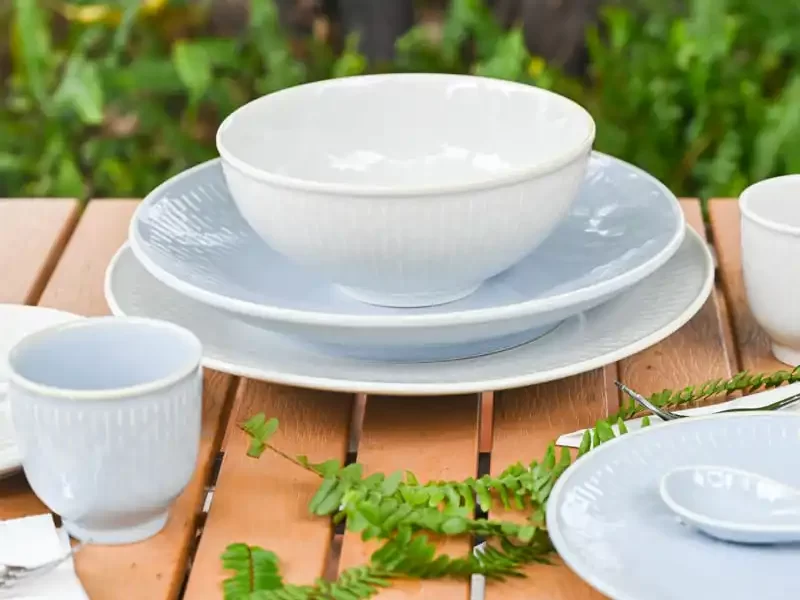
Vitrification happens during firing. The body turns glass-like, the pores close, and it becomes dense and non-absorbent.
A vitrified porcelain plates body that reaches full vitrification is harder at the edge and less likely to chip from small hits.
You can get a quick read in the receiving bay. Tap the plate and it should give a clean ring; the edge should feel tight; the weight should sit steady. These are useful field cues, not proof of full vitrification. For that, ask the supplier for a documented water absorption rate and the factory’s vitrification test report.
In a receiving check, tap the plate and look at the foot ring. That tells you more than a photo. A drop of water that beads on the surface is a rough cue, but it does not prove the body is fully vitrified. A high-fire plate and a low-fire plate with a shiny glaze can look alike in a quick test. The number that matters is the supplier’s documented water absorption (a fully vitrified body sits at or near 0%) and the factory’s test results.
Why do vitrified plates resist chipping?
The chip almost always starts at the rim or the foot, where two plates meet and rub. Three things decide if that contact becomes a break.
Firing temperature and body density. A high-fire body (fine porcelain is typically fired around 1320°C in a single high fire) tends to vitrify more fully than a low-fire body, which usually means fewer weak spots at the edge, though edge life also depends on glaze fit and how the piece is handled. Firing is one factor, not the whole story.
Edge finishing. The rim is the thinnest part. A clean glaze and a clean foot ring stop small cracks from growing into chips.
Glaze fit. The glaze and body must shrink together as they cool, so the surface stays under light compression and resists edge flaking. The foot ring matters most, because that is where most chips start. A clean, even ring lets the plate sit flat against its neighbor; when the ring is uneven, the rim takes the hit.
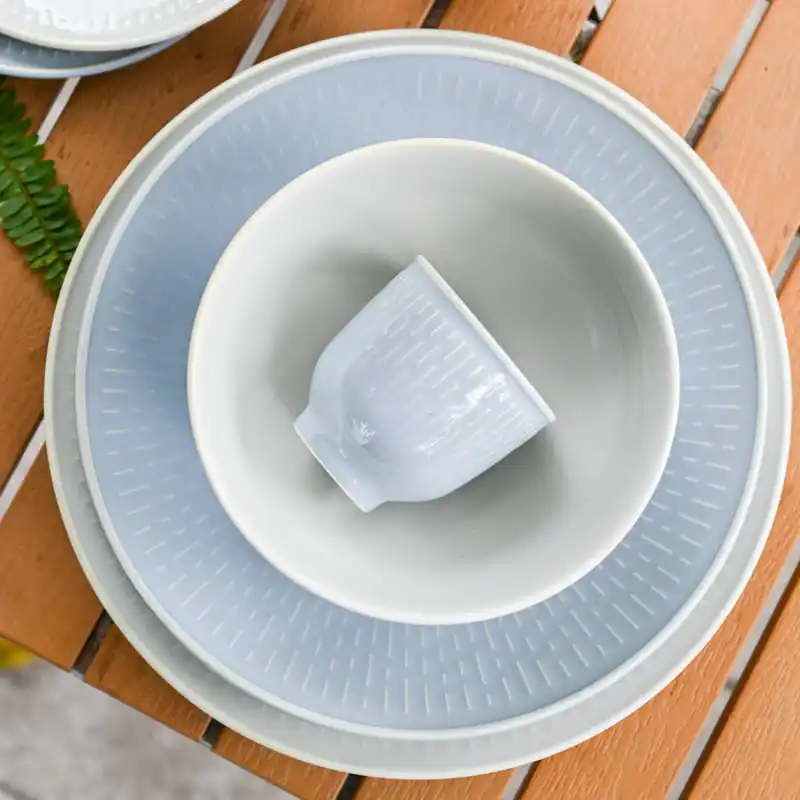
At P&T Royal Ware, our chip resistant dinnerware for hotels and restaurants uses this high-fire vitrified body. We write the spec so the 400th wash looks like the first.
| Property | Vitrified fine porcelain (P&T) | Low-fire earthenware |
| Body porosity | Very low (non-porous) | Higher (can absorb) |
| Edge hardness | High | Lower |
| Dishwasher load behavior | Stable over long runs | More prone to edge wear |
| Typical firing | High temperature, single fire | Lower temperature |
Is vitrified porcelain the same as bone china?
No. Vitrified describes how dense and non-porous the fired body is. Bone china is a family that includes fine china (no bone ash) and fine bone china (45% bone ash at P&T). Vitrified fine porcelain is a separate, bone-ash-free body. A plate can be vitrified without being bone china.
Each material fits a different scene:
- Fine porcelain (vitrified, high-fire), the chip-resistant workhorse for high-frequency, high-turnover service: banquets, buffets, daily restaurant runs.
- Fine bone china (45% bone ash at P&T), for premium dining where thinness, translucency, and hand-feel matter: fine-dining feature courses, afternoon tea. A venue built around that experience can run it daily too, since wash survival depends on glaze and decoration, not the body alone.
- Fine china (bone-ash-free, same family), a midweight step between fine porcelain and fine bone china for the bone-china look without the lightest body.
- Royal white porcelain, a clean uniform white across the whole top; its even surface makes any chip or stain obvious at a glance on the pass.
- Stoneware is heavier, fired lower, durable but not the same dense vitrified body. Earthenware is low-fire and porous, not suited to commercial dishwashing at scale.
The right choice follows the outlet. A banquet hall running thousands of covers wants the vitrified workhorse. A fine dining room builds its feature courses on fine bone china, where look and hand-feel carry the plating, but a venue designed around the premium experience can run it daily too. Let the wash load decide: daily machine use points to vitrified fine porcelain; a feature course can carry a finer body. A vitrified body ages evenly instead of growing weak spots that force a partial re-buy.
Tip: Vitrified does not mean unbreakable. It resists the slow edge wear that kills most plates. Train staff to stack with the foot seated, and the chip rate drops.

How do you read a chip-resistance spec before buying?
When a supplier gives you a spec sheet, look for points that predict field life:
- Firing temperature and method (single high-fire vitrified bodies last longer).
- Glaze hardness or abrasion rating, not just “scratch resistant” as a claim.
- Thermal shock tolerance, since plates move from cold prep to hot rinse.
- Foot ring quality, because most chips start where plates touch.
- Batch consistency, since a hotel cannot run a top that changes color between reorders.
Ask for the firing profile in writing before you order. Suppliers who fire to a controlled high temperature can give the number; those who cannot are often hiding a weak body behind a shiny glaze. If a spec skips these and leans on adjectives, ask for the test method. A serious hotel tableware supplier will show you the firing profile, not just the brochure.
We do not sell plates as a catalog line. For a hotel or restaurant, we build the table top as a tableware program, not a one-off purchase. The durability spec is part of step one, and the same program method has shaped tops for recognized names such as PITO, where a coherent set protects brand recognition from the first cover.
- Concept / Menu Analysis – We read the menu and the service style before suggesting any shape.
- Material & Shape Selection – We pick the vitrified fine porcelain body (or a fine bone china accent) to match the outlet.
- Custom Design – Our in-house team develops shape, glaze, and decal that carry the property’s brand.
- Sampling – You get a real piece to test on the pass, not a render.
- Operational Testing – We run stacking, busing, and wash-cycle checks before volume.
- Production / QC – Our factory fires to a controlled vitrified body under ISO 9001 quality management.
- Delivery – We plan par levels against your seat count and opening date.
- Replenishment – Reorders match the approved sample, supported by regional agents.
For the full method on standardizing a top, see Restaurant Dinnerware Sets: Standardizing Your Table Top. For wash-cycle survival, see Dishwasher Safe Porcelain Dinnerware: A Commercial Guide.
Frequently Asked Questions
Q: Are vitrified porcelain plates the same as bone china?
No. Vitrified describes how dense and non-porous the fired body is. Bone china is a family that includes fine china (no bone ash) and fine bone china (45% bone ash at P&T). Vitrified fine porcelain is a separate, bone-ash-free body. Many commercial tops are vitrified fine porcelain rather than bone china.
Q: Do vitrified plates still chip?
They can, but they resist the edge wear that ends most plates. The vitrified body is harder at the rim and less likely to flake during stacking and washing. Proper foot seating and busing habits extend their life further.
Q: Why choose chip resistant dinnerware for a restaurant?
A restaurant plate is handled far more often than a home plate, through stacking, busing, and commercial washing. Chip resistant dinnerware keeps the top presentable across long runs and reduces the cost of replacing mismatched pieces.
Q: Is vitrified porcelain safe for food contact?
Yes. Porcelain is a standard food-contact ceramic. Buyers can ask suppliers about compliance with standards such as ISO 6486 for ceramic articles in contact with food, and about the supplier’s own quality certification such as ISO 9001.
If you are specifying durable porcelain plates for a new opening or a refresh, send us the details that let us spec the right top:
- Project type (new opening / renovation / expansion)
- Service concept (fine dining / banquet / buffet / cafe)
- Expected quantity (by cover or by seat)
- Customization requirement (shape / glaze / decal / brand color)
Contact P&T Royal Ware with those four points and we will return a material and shape plan built around a vitrified, chip-resistant body.


LET'S TALK TOGETHER
Lorem ipsum dolor sit amet, consectetur estor adipi isicing elit, sed do eiusmod tempor este uterre incididui unt ut
