




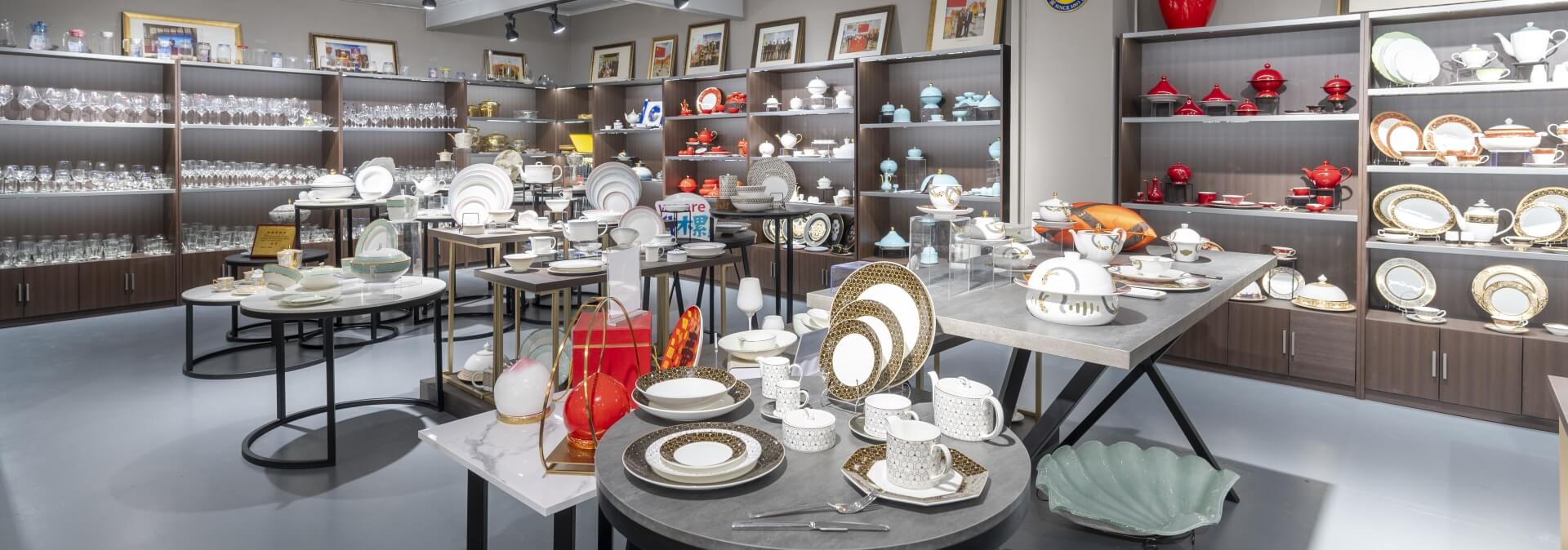
PITO Article
How Fine Porcelain is Made: From Kaolin to Kiln
Fine porcelain begins with high-purity kaolin clay. Skilled technicians shape, fire, and glaze each piece under controlled manufacturing standards. PITO integrates traditional craftsmanship with modern production technology.
Kaolin Clay and Raw Materials
What Makes Fine Porcelain Unique
Fine porcelain differs from ordinary ceramics in both material purity and performance. Its performance is determined primarily by the raw material composition. Porcelain uses kaolin clay. This clay contains minimal impurities and provides a fine, smooth texture. After forming and firing, the porcelain body becomes dense and structurally strong. This process requires firing at extremely high temperatures. The high-temperature firing vitrifies the body, creating a dense and non-porous structure. Premium porcelain may also offer controlled translucency. Its low water absorption prevents staining and supports hygienic food-service use. This makes porcelain ideal for commercial plates, bowls, and hotel tableware. Fine porcelain does not chip or crack easily. It maintains long-term durability even under intensive daily service.
Tip: High-purity kaolin provides whiteness, smooth texture, and firing stability. A balanced blend of kaolin, feldspar, quartz, and petuntse creates a dense, vitrified structure suited for hospitality use.
- High-purity kaolin ensures a refined and consistent surface texture.
- Firing at approximately 1320°C completes vitrification and produces a hard, non-porous body.
- Fine porcelain offers controlled translucency, high density, and excellent thermal-shock resistance.
- It exhibits extremely low water absorption.
- It provides excellent thermal-shock resistance for commercial kitchen environments.
Sourcing Kaolin and Minerals
Fine porcelain requires a balanced combination of kaolin and additional minerals. Feldspar, ball clay, quartz, and petuntse are important. Kaolin has kaolinite, which keeps porcelain pure. It also melts at a high temperature. Low iron in kaolin makes porcelain look white. China is one of the major global sources of high-quality kaolin. Careful mining and purification make sure the kaolin is high quality.
P&T Royal Ware sources low-iron kaolin from certified suppliers, ensuring consistent whiteness, purity, and firing performance. These standards make sure plates and bowls are safe and strong. Here is how P&T Royal Ware chooses its materials:
| Sourcing Standard | Description |
|---|---|
| Non-toxic & eco-friendly | Suppliers are selected to ensure all materials meet food-contact and environmental standards. |
| Efficient Production & Quality Control | Factories follow strict regulations for strong and reliable products. |
| Certification | Every step meets world safety and quality regulations. |
P&T Royal Ware’s material selection process ensures consistent performance, durability, and long-term reliability in commercial environments.
Shaping Fine Porcelain
Forming Techniques
Forming requires precision and control. P&T Royal Ware uses turning, isostatic pressing, slip casting, and press casting, depending on shape and production volume. These methods range from traditional craftsmanship to modern automated systems. Each one helps shape the clay in a special way.
The following are the most commonly used forming techniques:
| Forming Technique | Description |
|---|---|
| Turning | Clay is formed using a metal profile on a rotating wheel to produce symmetrical round shapes. |
| Isostatic press molding | High pressure compacts dry granules into a mold, making this method ideal for standardized plates and bowls used in hospitality service. |
| Slip casting | Liquid clay (slip) is poured into plaster molds, making this method suitable for hollowware and complex shapes. |
| Press casting | Slip is injected into two-part molds under pressure, enabling stable production of large or flat items such as platters. |
Additional forming methods include:
- Throwing: A potter’s wheel is used to create symmetrical ceramic forms.
- Molding: You press clay into a mold to get complex shapes.
- Slip casting: Slip is filled into molds to produce thin-walled items and high-volume commercial pieces.
Slip casting ensures excellent uniformity and high production efficiency, making it ideal for hotel and restaurant tableware sets. Wheel throwing produces unique pieces, but it is slower and less consistent.
In Addition: Slip casting is perfect if you want to make a set of plates or cups that all look the same.
Molding and Casting
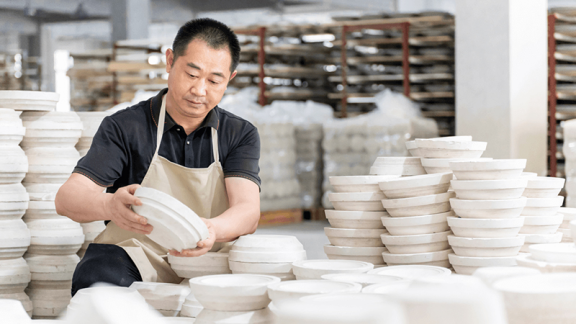
Molding and casting are used to create fine porcelain pieces with specialized or complex shapes. This process supports the production of both simple forms and highly detailed designs. The primary steps of the process include:
- Ceramic slurry (liquid clay) is applied to the mold interior.
- The slurry starts to dry and forms a thin layer on the mold’s surface.
- Once the layer reaches the desired thickness, it is removed as a shaped green body.
- The piece undergoes a pre-drying stage to eliminate remaining moisture.
- The green body undergoes controlled pre-drying and initial firing to stabilize the structure.
Modern manufacturing technology has significantly improved molding and casting efficiency. Advanced methods such as direct solidification forming and 3D printing enable the efficient production of large or complex shapes with reduced material waste. Techniques like colloidal vibration injection molding support high-volume, continuous production. These advances mean you can create fine porcelain that is both beautiful and strong.
PITO’s Design Innovation
P&T Royal Ware leads the way in design and craftsmanship. The brand collaborates with international designers and holds over 100 product design patents. The brand has earned over 100 product design patents. This shows their commitment to new ideas and unique styles.
P&T Royal Ware offers full customization services to create custom porcelain that matches your vision. The design team collaborates with clients to develop tailored colors, patterns, and shapes. With more than twenty years of experience, PITO ensures each piece meets high standards for quality and beauty.
- P&T Royal Ware collaborates with renowned designers to develop professional-grade porcelain collections.
- The team uses advanced design techniques.
- Hotels can request customized shapes, colors, and patterns to support branded dining concepts.
PITO combines traditional craftsmanship with modern innovation to deliver distinctive, high-performance porcelain for professional use. Their expertise helps you bring your ideas to life, whether you need classic dinnerware or something bold and new.
Firing and Glazing Process
P&T Royal Ware uses a single high-temperature firing process to produce hospitality-grade porcelain. This method ensures structural strength, glaze stability, and consistent product quality across large-scale hotel and restaurant orders.
High-Temperature Firing at 1320°C
After shaping, drying, and glazing, each piece is fired once in a modern kiln at approximately 1320°C.
At this temperature:
- The porcelain body becomes fully vitrified, forming a dense, glass-like structure.
- The glaze melts and bonds evenly with the body, producing a smooth and durable surface.
- Water absorption drops to near zero, which is essential for hygiene and stain resistance in professional food-service environments.
- The body achieves its required whiteness, translucency, strength, and thermal stability.
This single-firing method meets international hospitality standards and ensures each piece can withstand intensive, high-turnover use.
Why Single Firing Benefits Hospitality Operations
Single firing at 1320°C provides:
- Greater firing stability and reduced deformation
- Strong mechanical performance suitable for commercial dishwashers
- Uniform color and glaze quality across large production batches
- Higher production efficiency, ideal for bulk hotel and catering orders
- Consistent plate weight and shape, important for plating and service workflow
This process aligns with the requirements of luxury hotels, fine dining restaurants, and large-scale catering venues.
Glazing for Durability
Before firing, each piece is coated with a carefully formulated glaze. During the 1320°C firing:
- The glaze melts into a dense, glassy layer
- The surface becomes resistant to scratches, metal marking, and staining
- The gloss level remains stable over the years of service
- The finished surface is hygienic and easy to clean during high-frequency restaurant operations
High-alumina and high-silica glaze compositions are used to enhance hardness and long-term performance.
PITO’s Quality Assurance System
P&T Royal Ware follows comprehensive QC protocols covering whiteness, dimensional accuracy, glaze stability, stain resistance, and flexural strength. P&T Royal Ware uses modern kilns to control heat and time. This makes sure plates and bowls are strong and smooth.
Comprehensive quality control is essential throughout production. PITO tests every batch in many ways:
| Quality Control Measure | Description |
|---|---|
| Whiteness Test | Evaluates surface brightness and whiteness consistency. |
| Deviation in Length and Width | Makes sure each piece is the right size. |
| Glossiness Test | Measures glaze reflectivity and gloss level. |
| Stain Test | Assesses the glaze’s resistance to staining agents. |
| Deviation in Thickness | Ensures uniform wall thickness for durability and consistency. |
| Flexural Strength Test | Measures the porcelain’s resistance to bending stress before fracture. |
| Surface Flatness Test | Make sure each piece is the right size. |
| Rectangularity Test | Look for a smooth, flat surface. |
P&T Royal Ware’s team follows strict protocols at every step. Each piece is engineered to meet safety, durability, and visual-presentation requirements for commercial use. Precision manufacturing ensures long-term performance and consistent presentation quality.
Decoration and Finishing Touches
Artistic Techniques
Skilled artisans apply multiple techniques to decorate fine porcelain. Porcelain painting uses under-glaze, glaze, and on-glaze.
Under-glaze painting applies color before glazing to protect designs during firing.
Glaze decoration: fired under a protective glaze layer.
On-glaze painting incorporates minerals and gold to enhance color and detail after glazing. Relief techniques create raised patterns through layering or carving the porcelain surface. These methods give each piece a special look and feel.
In addition, hand-painted porcelain holds greater artistic and market value. Hand-painted pieces reflect the artisan’s personal skill and creative vision. Subtle variations in design and texture ensure that each plate or bowl is unique.
Decal Application
Decals enable precise application of patterns and logos. Application steps include:
- Fire the porcelain and clean the surface.
- Cut the decal and soak it in water until it peels.
- Moisten the porcelain, align one edge of the decal, and remove the backing carefully.
- Use a damp sponge and paper towel to remove air and water.
- Fire the piece again to set the decal.
Product Excellence: Best Porcelain Dinnerware
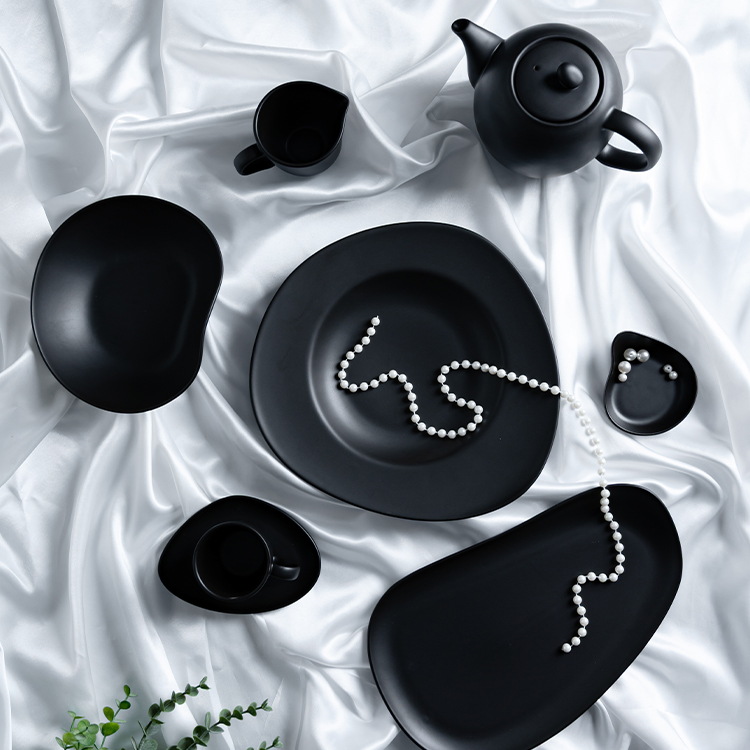
P&T Royal Ware’s Best Porcelain Dinnerware and Black Plates Sets are strong and stylish. The brand uses bone china and high-temperature porcelain. These materials do not chip or scratch easily. P&T Royal Ware combines traditional craftsmanship with modern design for long-lasting and refined porcelain.
Applications in Hospitality
PITO in Hotels and Restaurants
Fine porcelain enhances dining experiences in luxury hotels and high-profile events, with P&T Royal Ware widely selected for its quality. Chefs and hospitality managers choose PITO for its elegance and durability. Every plate and bowl elevates the dining experience. Here are some places that use PITO:
| Example | Description |
|---|---|
| Bocuse d’Or Culinary Competition | Top chefs use PITO’s porcelain and bone china. They want plates that look good and last long. |
| Dubai Emaar Beach Resort | This resort picks PITO for elegant and tough dinnerware in dining rooms and banquets. |
| Katara Fairmont Hotel | PITO porcelain is selected for its balance of strength, presentation quality, and long-term reliability in premium hotel operations. |
PITO’s products are found where superior quality is critical.
Product Features and Value
PITO porcelain meets global food-contact and durability standards, including FDA, LFGB, CE, ISO9001, and Prop 65. PITO’s porcelain has many good points. The dishes do not chip or scratch easily. Their smooth surface makes cleaning simple. You can use them in microwaves and dishwashers. PITO’s products follow strict safety rules. Here are some certifications they have:
| Certification/Standard | Description |
|---|---|
| FDA | Ensures safety for food contact surfaces. |
| California Prop 65 | Meets rules for lead and cadmium in tableware. |
| CPSIA | Verifies safety for children’s products. |
| CE | Shows health, safety, and environmental protection. |
| LFGB | Ensures food safety and hygiene in Germany. |
| ISO9001 | Guarantees consistent product quality. |
With extensive certifications, PITO dinnerware ensures longevity and guest safety in professional hospitality settings.
Black Porcelain Dinner Plate Gold Rim
The Black Porcelain Dinner Plate with Gold Rim offers elegant design, durable porcelain, and a striking black-and-gold appearance. Key advantages of this plate include:
- Gold rim enhances elegance for formal dining occasions
- Porcelain is tough and does not chip or scratch
- Good size for main dishes
- Balanced weight improves handling efficiency for service staff
- Black and gold colors stand out
- Safe for microwave and dishwasher
Designed for high-end hospitality, this plate enhances memorable dining experiences.
Fine porcelain begins with clean kaolin clay. Workers shape, heat, and decorate each item with care. PITO makes sure every plate is well-made and looks nice. You get dinnerware that is pretty and lasts a long time.
Each piece reflects P&T Royal Ware’s commitment to precision, craftsmanship, and long-term performance in professional hospitality service.
| Rating | Percentage |
|---|---|
| 5-star | 95% |
| 4-star | 5% |
| 3-star | 0% |
| 2-star | 0% |
| 1-star | 0% |
- “They worked hard to send my order to a country they do not ship to often. Thanks!” – Martin S.
Each piece of PITO fine porcelain demonstrates expert craftsmanship and intrinsic value.


LET'S TALK TOGETHER
Lorem ipsum dolor sit amet, consectetur estor adipi isicing elit, sed do eiusmod tempor este uterre incididui unt ut
