




PITO Article
Fine Porcelain Dinnerware for Commercial Kitchens
Buying fine porcelain dinnerware for a commercial kitchen is less about the pattern and more about the spec. In a dishroom that runs hundreds of covers a shift, the body has to survive the dishwasher, the stack, and the drop, and still look clean at service. This guide gives procurement teams a practical spec checklist, explains how it differs from cheaper ceramic, and shows where porcelain dinnerware fits a high-volume program. It includes notes from P&T Royal Ware’s commercial grade table and our reinforced Royal Porcelain line, plus context from our porcelain dining sets guide.
What “Fine Porcelain” Means
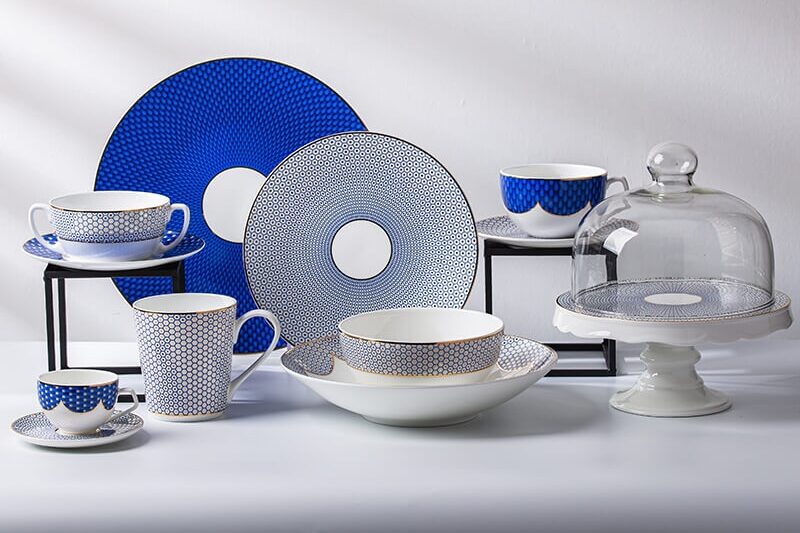
“Fine porcelain” is high-temperature vitrified porcelain. It is fired dense enough that water absorption drops below 0.5%, leaving a glass-like, non-porous body. That property lets fine porcelain dinnerware take repeated dishwasher heat without crazing or staining. It is the basis for our premium fine porcelain bodies. Our separate bone china line adds the bone-ash option for top-tier zones.
Tip: “Fine porcelain” is not a marketing word here. It is the firing result. Ask for the absorption test, not the label.
P&T Royal Ware’s Royal Porcelain is a reinforced fine porcelain made for higher impact resistance, so it lasts longer in commercial dishrooms than a standard body.
Every batch at P&T Royal Ware is fired to a documented curve and tested for absorption before it leaves the kiln. The “fine porcelain” label is backed by a number, not a promise.
Spec Checklist for Fine Porcelain Dinnerware
Fine porcelain dinnerware spec table: walk this with any supplier and the real grade shows up fast:
| Check | Target | Why it matters |
|---|---|---|
| Water absorption | < 0.5% | Vitrified, hygienic |
| Glaze | FDA / LFGB / EU 10-2011 | Food-contact legal |
| Cadmium & lead | ISO 6486 limit | Safety release test |
| Thermal shock | Withstands dishwasher | No cracking |
| Edge / rim | Rolled or reinforced | Resists chipping |
| Weight per piece | Listed | Freight and stack math |
For a body-by-body comparison, see our bone china vs porcelain hotel guide.
Commercial dishwashers run hotter and faster than home units, and that is where weak bodies fail. For fine porcelain dinnerware, three properties decide lifespan:
- Glaze stability: a certified glaze resists crazing after thousands of cycles.
- Thermal shock: vitrified fine porcelain handles the swing from washer to plate warmer.
- Microwave safety: no metallic trim. Plain bodies heat cleanly.
- Edge and rim: a rolled or reinforced rim takes the knock that would chip a thin, unprotected edge. Most commercial breakage starts at the rim.
Note: Gold or hand-painted rims look premium but fail the commercial dishwasher. Keep fine china dinnerware with metallic trim for low-volume signature service, not the dishroom.
A commercial kitchen lives or dies by shelf density. With royal white porcelain and fine porcelain bodies:
- Flat stacking: rolled rims let plates nest without pressure points.
- Bowl-on-plate: designed foot rings stack bowls on plates to save height.
- Open stock: keep one SKU per high-breakage piece so a crack never forces a full re-order.
Good stacking design cuts breakage at the shelf, before it reaches the table. P&T Royal Ware publishes per-piece height and stacking limits so your shelving plan is math, not guesswork.

Vitrified Porcelain Dinnerware vs Cheap Ceramic
| Property | Vitrified fine porcelain | Cheap ceramic / earthenware |
|---|---|---|
| Water absorption | < 0.5% | Often > 5% |
| Dishwasher | Safe for years | Crazes, stains |
| Weight | Light, thin | Heavy, thick |
| Lifespan | Long | Short |
| Cost per cover | Lower over time | Higher over time |
The right column is cheaper at the register and more expensive everywhere else. For the full material-family view, our ceramic dinner set vs porcelain guide covers earthenware, stoneware, and porcelain.
Lifecycle Cost
The purchase price of fine porcelain dinnerware is the smallest line in the annual math. Two numbers dominate:
- Breakage rate: a reinforced Royal Porcelain body can cut replacements by a clear margin in high-turnover kitchens. Across a 200-cover kitchen, even a 10% drop in annual breakage often pays for the upgrade within the first year.
- Reorder friction: open-stock availability beats forced bundle re-orders. When a single cup SKU is always available, a busser replaces one piece instead of a manager approving a full case.
Tip: When two quotes look close, run a 12-month cost model with your real breakage history before you pick the lower unit price.
Procurement Timeline, MOQ, and Container Planning
Specifying fine porcelain dinnerware is only half the work. The order has to land before service starts. Three planning points keep a launch on track:
- Lead time: custom decal or embossing adds weeks versus plain white. Confirm the clock before you promise an opening date.
- MOQ per piece: high-volume pieces (dinner plate, bowl) usually carry a lower minimum than signature items. Plan the mix so the container fills efficiently.
- Mixed loading: combining dinnerware sets for restaurants with other bodies in one container lowers per-piece freight.
P&T Royal Ware quotes lead time against the spec, giving the dishroom a buffer to train staff before service starts.
Frequently Asked Questions
Q: Is fine porcelain dinnerware safe for commercial dishwashers?
Yes, when vitrified and glaze-certified. Look for under-0.5% water absorption and FDA/LFGB/EU glaze certification. Those are what survive daily high-heat washing.
Q: What is the difference between porcelain dinnerware and fine china dinnerware?
Porcelain dinnerware is a high-temperature vitrified body (fine porcelain). Fine china dinnerware is a refined vitrified body without bone ash, made for clean daily service. For a more premium, translucent look, the separate fine bone china line adds real bone ash, but that is its own body, not a variant of fine china.
Q: Can we add our logo to fine porcelain dinnerware?
Yes. Through OEM/ODM, P&T Royal Ware fires a bottom logo and decal into the glaze so it survives the dishwasher instead of peeling off like a sticker.
Q: How many fine porcelain dinnerware pieces should a new kitchen open with?
Plan roughly 3× your peak seat count in dinner plates, plus 1.5× in bowls and side plates. The dishroom keeps rotating while a batch is in the washer, the same ratio we use for porcelain dining sets.
Fine porcelain dinnerware pays for itself in the dishroom, not the showroom. Set the spec, confirm vitrification, and choose a reinforced body where turnover is highest.
Ready to build your fine porcelain dinnerware program? Contact P&T Royal Ware for a spec checklist and a quote matched to your kitchen.


LET'S TALK TOGETHER
Lorem ipsum dolor sit amet, consectetur estor adipi isicing elit, sed do eiusmod tempor este uterre incididui unt ut
