




PITO Article
How to Check the Quality of Bone China Tableware
Many buyers focus only on how beautiful bone china tableware looks, while ignoring a more important factor: quality. No matter how exquisite the design is, if the quality is lacking, issues like cracks, glaze peeling, or uneven coloring can appear during use. So how can you tell if a set of tableware meets the standard? Is there a clear checklist for quality? This guide compiles a bone china tableware quality inspection checklist to help you quickly master the essentials of selecting high-quality pieces.
This article is divided into three sections:
- Basic principles for checking bone china tableware
- Key visual checks for different types of tableware (plates, bowls, cups, teapots, spoons)
- Special tests (weight-bearing, scratch resistance, dishwasher and microwave safety)
1. Basic Tips for Checking Bone China
Start with the most straightforward checks—look and feel. Pick up a piece and feel its surface. Good bone china should feel smooth like silk, without any grainy texture or bumps. Check carefully for cracks, chips, or areas where the glaze is peeling—these are clear signs of poor quality.
Next, place the tableware on a flat surface and see if it wobbles. If a plate or bowl tilts or feels unstable, the shape may be off, or the body may not be properly formed. You can also try the tap test: gently tap the piece or let two pieces clink together. A clear, resonant sound indicates proper firing; a dull sound, like tapping wood, may signal hidden cracks or insufficient firing.
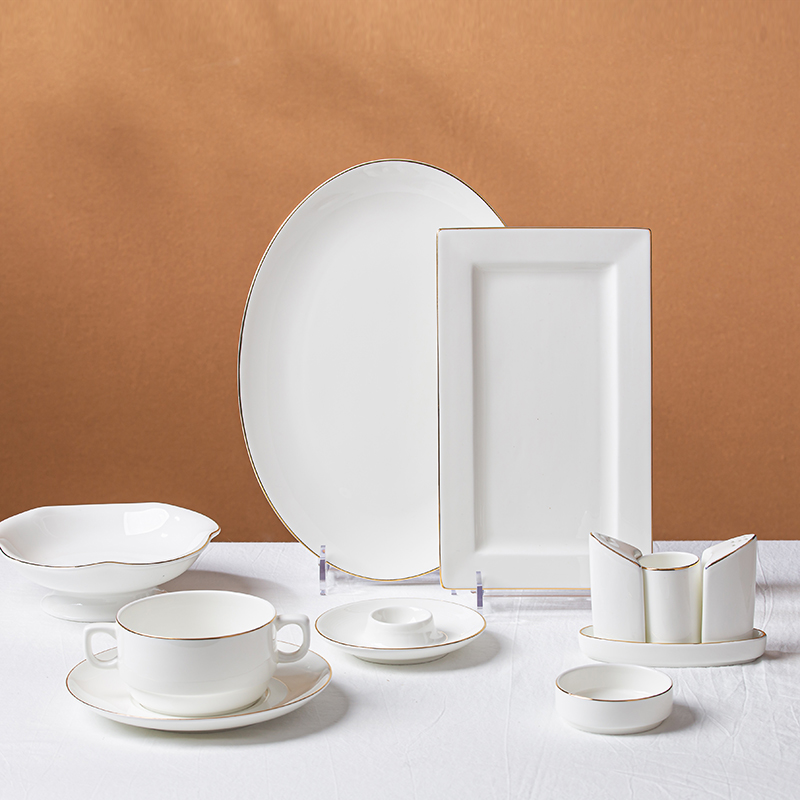
For tableware with patterns or gilded edges, gently rub the surface to see if the design is firmly attached. Patterns and colors should be consistent across the set. High-quality bone china usually has a warm, creamy-white tone, with thin yet evenly thick walls. Interiors are often plain white, which is safer and more hygienic.
2. Key Checks for Different Types of Tableware
Each type of bone china tableware has its own “checkpoints.” Here’s a breakdown by category:
2.1. Plates and Bowls
- Surface defects: Front side should have no more than 2 black spots, color specks, or glaze flaws; back side can allow up to 3 minor flaws. Total defects ≤2.
- Shape consistency: Large plates and bowls may warp; edges should be smooth and symmetrical.
- Bottom stability: Should sit flat without wobbling. Black marks on the base should cover no more than a quarter of the area.
- Base finishing: Bottom should be smooth, free of burrs, to avoid scratching hands or surfaces.
- Size tolerance: Plates and bowls ≤9 inches: ≤3% deviation; >9 inches: ≤2.5% deviation.
- Cleanliness and packaging: Pieces should be clean, and packaging sturdy for safe transport.
2.2. Cups and Saucers
- Color matching: Cups and saucers should have consistent color with no noticeable differences.
- Saucer grooves: Must fit cup bases properly; too shallow or deep can cause instability.
- Handle attachment: Check for cracks and proper alignment.
- Size tolerance: ≤3% deviation.
2.3. Teapots
- Spout and handle: Spouts should be uniform and free of residual glaze; handles should be firmly attached without cracks.
- Pouring holes: Holes should be evenly spaced and the right size, without blockage.
- Lid fit: Lids should sit securely without slipping when pouring.
- Mold lines and color: Body, lid, and handle should show minimal seam lines and consistent color.
2.4. Spoons
- Handle hole: Centered, smooth, free of burrs, and consistent across pieces.
- Size tolerance: ≤3% deviation.
3. Special Tests: Ensuring Durability
Appearance alone isn’t enough—durability is just as important. The following tests can help confirm that your tableware can withstand everyday use:
3.1. Weight-Bearing Test
Handles and spouts, especially on cups and teapots, need to be strong enough to handle hot liquids. Weak construction can lead to breakage and burns. Fill with hot water to check handle stability.
3.2. Scratch Resistance
Tableware inevitably encounters knives, forks, or abrasive surfaces. High-quality bone china is hard enough to resist scratches. You can test with a Mohs hardness test, metal cutlery, or sandpaper to ensure the surface doesn’t easily scar.
3.3. Microwave Test
If labeled microwave-safe, check the following:
- Decorative patterns remain intact after heating.
- Surface temperature does not spike excessively.
- Structure remains stable under heat.
Conclusion
When choosing bone china, don’t focus only on pretty patterns—quality matters most. Follow this checklist, inspecting everything from appearance to durability. This approach ensures every piece meets standards, enhancing your dining experience and adding value to your restaurant or brand. Remember, the key principle in selecting tableware is: quality, quality, and quality.
With this guide, finding your ideal set of bone china tableware becomes much easier. If you have further questions, feel free to ask anytime.


LET'S TALK TOGETHER
Lorem ipsum dolor sit amet, consectetur estor adipi isicing elit, sed do eiusmod tempor este uterre incididui unt ut
