




PITO Article
The Role of Kaolin, Feldspar, and Quartz in Porcelain Body Formulation
In hospitality-grade porcelain manufacturing, three core minerals—kaolin, feldspar, and quartz—form the foundation of performance-driven tableware. Kaolin contributes structural strength and refined translucency, while feldspar and quartz enable controlled vitrification, delivering the durability required for commercial dining environments.
When these materials are precisely balanced, porcelain achieves a level of consistency, resilience, and visual refinement that surpasses conventional ceramics. This formulation discipline is especially critical in premium hospitality collections, where brands such as PITO focus on long-term performance, aesthetic stability, and operational reliability.
Key Materials in Porcelain Formulation
Kaolin’s Structural Role
Kaolin functions as the structural backbone of porcelain, providing the plasticity required for precise shaping while maintaining dimensional stability during high-temperature firing. Its high melting point ensures plates and serving ware retain their form—an essential requirement for large-scale, consistent production.
High-purity kaolin with low iron content delivers a clean, white appearance, supporting the visual standards expected in luxury hotels and professional dining venues. Above 1000°C, kaolin transforms into mullite, reinforcing the internal microstructure and enhancing resistance to deformation and mechanical stress.
The table below outlines the key properties that make kaolin indispensable in commercial porcelain formulation:
| Property | Description |
|---|---|
| Plasticity | Fine particle size and plate-like structure provide excellent shaping ability. |
| High Melting Point | Maintains integrity during firing above 1,700°C. |
| Purity and Whiteness | Ensures a bright, translucent appearance. |
| Low Iron Content | Prevents discoloration for a pristine look. |
| Transformation to Mullite | Forms mullite above 1000°C, crucial for strength. |
Feldspar as Vitrifying Agent
Feldspar serves as the primary vitrifying agentin hospitality-grade porcelain bodies, introducing fluxing oxides that promote controlled melting and the formation of a stable glassy phase during firing. This vitrification process binds ceramic particles together, creating the dense, non-porous structure required for high-traffic hotel and restaurant use.
Typically beginning to melt at approximately 1150°C, feldspar performs optimally at 25–35% content in porcelain formulations. At this range, it lowers the maturing temperature while enhancing fired strength and translucency—two critical attributes for commercial tableware that must balance durability with refined appearance.
- Feldspar provides the flux required for effective vitrification in commercial porcelain bodies.
- It binds the ceramic matrix, forming a smooth, glassy surface that supports both hygiene and aesthetics.
- Proper feldspar content enhances resistance to chipping and surface wear, extending product lifespan in hospitality operations.
Quartz for Stability
Quartz plays a critical role in stabilizing porcelain bodies for commercial production, contributing both mechanical strength and thermal reliability. As a non-plastic raw material, it moderates plasticity and reduces drying shrinkage, supporting dimensional accuracy during forming and drying.
During firing, quartz helps counteract excessive shrinkage and increases melt viscosity, minimizing risks such as deformation or softening. It also forms a skeletal framework within the body, reinforcing mechanical strength and thermal stability—key requirements for porcelain subjected to frequent washing, temperature fluctuations, and daily service cycles.
The table below summarizes the functional contributions of quartz in hospitality-grade porcelain:
| Aspect | Contribution of Quartz |
|---|---|
| Mechanical Strength | Increases overall strength of porcelain bodies. |
| Thermal Expansion | Improves thermal and dimensional stability. |
| Firing Process Behavior | Supports mullite and vitreous phase formation for added stability. |
| Residual Stress | Creates compressive stress, reducing risk of cracks. |
| Crystalline Phase | Most abundant crystalline phase, critical for product performance. |
PITO upholds strict sourcing standards for all raw materials. You can trust that every batch of kaolin, feldspar, and quartz meets non-toxic, eco-friendly, and certified quality benchmarks. This commitment ensures your porcelain achieves the highest standards of safety, durability, and visual appeal.
Impact on Porcelain Properties
Strength and Durability
In hospitality-grade porcelain, strength and durability are determined by the precise balance of kaolin, feldspar, and quartz, each contributing a distinct function to the fired body. Kaolin establishes the structural framework, feldspar drives vitrification and density, and quartz reinforces mechanical resistance.
Adjusting these proportions directly impacts how well porcelain withstands daily service demands in hotels, restaurants, and catering operations, including repeated handling, washing, stacking, and transport.
The following table shows how different proportions affect mechanical strength and durability:
| Component | Role (The Metaphor) | Actual Effect on Strength & Durability |
|---|---|---|
| Kaolin | The Skeleton | Provides Structural Integrity. Converts to Mullite to prevent warping during firing. Too much can reduce translucency, but it is essential for the body’s shape. |
| Feldspar | The Glue | Provides Density. Melts to fill voids (pores) between particles. It is the primary driver of vitrification, ensuring the plate is non-porous and chip-resistant. |
| Quartz | The Muscle | Provides Hardness. Acts as a filler to resist wear and deformation. It increases mechanical strength but must be balanced to avoid thermal shock (cracking under temp changes). |
Increasing quartz content enhances mechanical strength, but excessive kaolin can reduce translucency—an important consideration for luxury hospitality tableware. Achieving this balance is critical in commercial production, where durability must align with visual refinement.
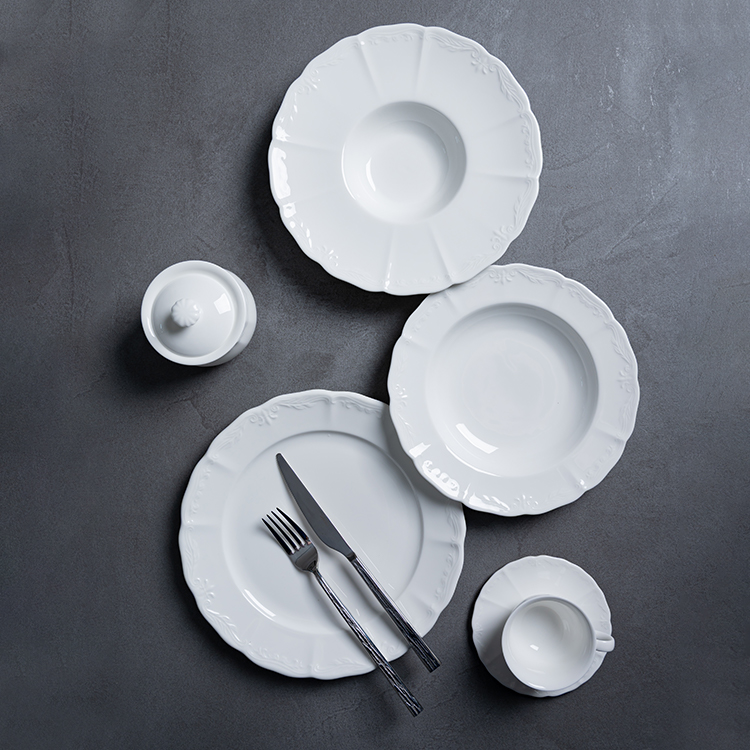
PITO’s Premium Fine Porcelain Plates exemplify this formulation discipline, delivering high impact resistance and reduced chipping rates—qualities that support long service life and lower replacement costs in hotels and restaurants.
Laboratory evaluations further indicate that selected material additions, such as spodumene tailings, can improve flexural strength and thermal stability when applied within an optimal range of 25–35 wt%.
This data-driven formulation approach ensures porcelain bodies meet the strength, reliability, and consistency standards required for professional hospitality use, rather than relying on trial-and-error adjustments.
Translucency and Whiteness
Translucency and whiteness distinguish premium porcelain from standard ceramics, particularly in upscale dining environments where presentation is integral to the guest experience. High-purity kaolin with low titanium and iron content enhances light transmission while maintaining a clean, refined white tone.
Feldspar contributes to translucency by promoting vitrification, though excessive levels may compromise structural stability if not properly balanced. Quartz, when precisely calibrated alongside kaolin and feldspar, ensures that visual refinement does not come at the expense of performance.
Here is a summary of how each material affects translucency and whiteness:
| Material | Effect on Translucency and Whiteness |
|---|---|
| Kaolin | Low titanium and iron content enhances translucency. |
| Feldspar | Affects translucency and stability; higher content improves translucency but reduces stability. |
| Quartz | Used in balance with kaolin and feldspar for desired properties. |
You can see the difference when you compare product types:
| Product Type | Translucency Description |
|---|---|
| Bone China | Distinctive glow when held to light |
| Standard Porcelain | Opaque or semi-opaque |
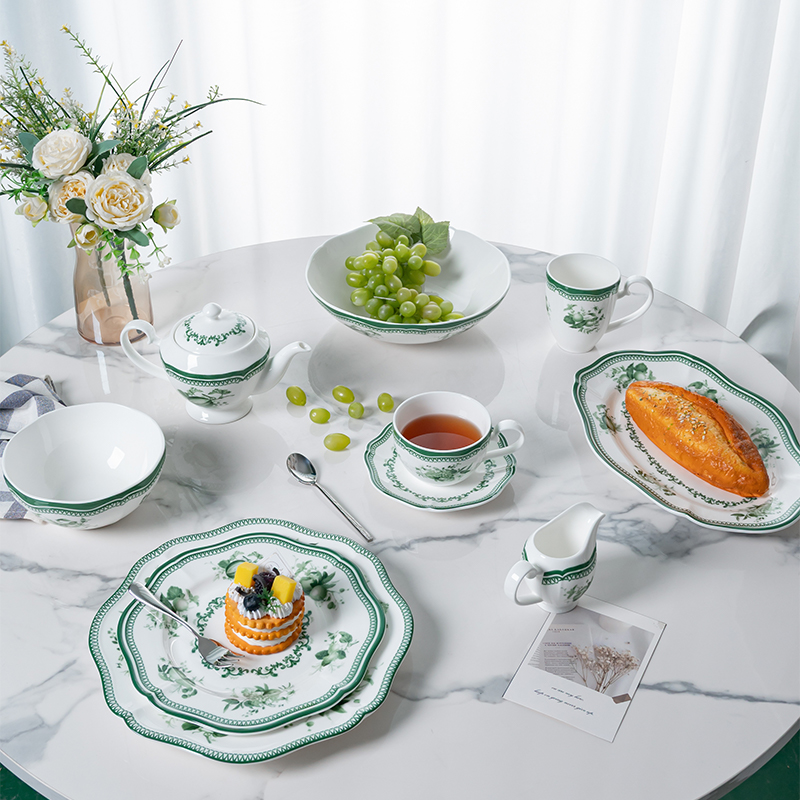
PITO’s Flower Decal Green Dinnerware Set and Horeca Blue Flower Porcelain Dinner Plate both showcase excellent whiteness and controlled translucency. These features create a refined dining experience and elevate the visual appeal of your table settings.
Note: Studies show that whitening agents and the balance of kaolin, quartz, and feldspar can influence the overall appearance of porcelain, especially in dental and hospitality applications.
Workability and Forming
Workability and forming behavior are decisive factors in large-scale porcelain production, particularly for commercial and hospitality tableware. A well-balanced body formulation ensures consistent shaping, smooth surfaces, and reduced defect rates throughout manufacturing.
When this balance is not maintained, defects such as craters, black specks, or reduced frost resistance may occur—leading to yield loss and inconsistent quality. Insufficient mullite formation or inadequate aluminum oxide content can result in unbound SiO₂, complicating production control and compromising the strength of the fired body.
Common forming challenges in commercial porcelain production include:
- Surface defects such as craters and black specks, which reduce strength and frost resistance.
- Low mullite content, leading to diminished physical and mechanical performance.
- Insufficient aluminum oxide levels, resulting in unbound SiO₂ during high-temperature firing.
These challenges are mitigated through the use of high-quality raw materials and precise formulation control. PITO’s White Vintage Floral Plates demonstrate how advanced forming techniques and strict quality management preserve shape accuracy and surface integrity. This consistency is especially valuable for large banquet programs and customized hospitality orders, where uniform appearance and predictable performance are essential.
Tip: Always monitor the balance of kaolin, feldspar, and quartz during production. This practice ensures that your porcelain remains easy to form, strong, and visually appealing.
Porcelain Body Ratios and Formulation
Standard Mixing Ratios
Consistent quality in commercial tableware begins with precise material proportions. Industry-established ratios for kaolin, feldspar, and quartz provide a reliable foundation for producing hospitality-grade porcelain with predictable performance:
| Component | Cone 10 Ratio | Cone 6 Ratio |
|---|---|---|
| Kaolin | 25%-50% | 20%-40% |
| Feldspar | 25% | 35% |
| Quartz | 20%-25% | N/A |
These ratios enable precise control over density, water absorption, and fired strength. For example, a 50:25:25 blend (kaolin:feldspar:quartz) produces a dense porcelain body with low water absorption and high fired strength—ideal for hospitality environments requiring durability and hygiene.
PITO’s manufacturing process is designed to maintain these ratios consistently, ensuring each production batch meets stringent hospitality performance standards.
Effects of Ratio Variations
Adjusting the proportion of each raw material directly influences the final performance and manufacturing behavior of porcelain tableware. The table below summarizes how ratio variations affect firing behavior, densification, and long-term stability in commercial production:
| Material Ratio | Effect on Properties | Observations |
|---|---|---|
| Feldspar | Raises optimal firing temperature | Lower densification efficiency at higher temperatures |
| Kaolin | Increases mullite formation and structural strength | Influences melt composition and sintering kinetics |
| Quartz | Boosts silica content and affects melt polymerization | Alters physical properties and stability |
Tip: In addition to material ratios, particle size distribution and compaction pressure significantly influence densification, shrinkage, and water absorption. Higher forming pressure supports greater dimensional consistency, particularly in thicker plates and serving ware commonly used in hospitality settings.
Practical Formulation Tips
Porcelain body formulation can be optimized by adhering to established industry guidelines:
- Select kaolin with low iron, magnesium, and titanium content to enhance translucency and color stability.
- Blend complementary kaolins, such as Grolleg and New Zealand, to balance workability with visual refinement.
- Maintain a Si:Al ratio close to 4:1 to achieve optimal fired performance.
- Adjust feldspar content according to firing temperature requirements.
- Target water absorption rates below 2% to ensure hygiene, durability, and suitability for hospitality use.
- Increase alumina to improve strength, while avoiding excessive reduction that may weaken the body.
PITO’s precise blending systems and advanced quality control protocols ensure that every piece of tableware consistently delivers the performance, safety, and elegance required in luxury hospitality environments.
Manufacturing Fine Porcelain at PITO
Forming and Shaping Techniques
You begin with a careful selection of raw materials. Skilled artisans and advanced machinery work together to shape each piece with precision. At PITO, you use forming methods such as casting, pressing, and hand-throwing. These techniques allow you to create diverse shapes and designs for tableware. Casting and pressing offer efficiency and uniformity, while hand-throwing on a potter’s wheel brings symmetry and customization. Shaping porcelain clay into vessels tests your concentration and skill. Each method contributes to the final product’s quality and finish.
- Shaping involves forming clay into specific shapes.
- Casting and pressing provide consistency for large batches.
- Hand-throwing delivers unique, symmetrical pieces.
High-Temperature Firing Process
PITO employs high-temperature kiln firing to achieve full vitrification, a critical factor in producing porcelain suitable for intensive hospitality use. Firing schedules are carefully controlled to optimize density, translucency, and mechanical strength.
- Bisque firing is conducted at approximately 1300°C–1320°C, stabilizing the body structure.
- Glaze firing follows at around 1280°C, ensuring glaze maturity, surface integrity, and long-term durability.
These firing parameters result in a dense, non-porous porcelain body that resists moisture absorption, thermal shock, and deformation—essential characteristics for hotel and restaurant environments where tableware is exposed to frequent washing, stacking, and temperature variation. The table below outlines the firing steps and their impact:
| Firing Technique | Temperature Range (°F) | Purpose |
|---|---|---|
| Oxidation (Cone 10-11) | 2350-2390 | Full vitrification, strength |
| Reduction (Cone 12-13) | 2406-2446 | Enhanced finish, durability |
High firing temperatures result in a dense, non-porous structure. You achieve the desired translucency and strength for hospitality-grade tableware.
Glazing and Quality Control
Glazing at PITO is performed using both automated and controlled manual processes, depending on design and finish requirements. All glazes are formulated to meet food-contact safety standards and are free from harmful substances. These measures ensure each piece meets high standards for durability and safety. The table below summarizes key quality control tests:
| Quality Control Measure | Description |
|---|---|
| Thermal Shock Endurance | Tests resistance to rapid temperature changes |
| Chipping Resistance | Assesses durability against chipping and breaking |
| Water Absorption | Measures porosity and structural integrity |
| Microwave Safety | Verifies suitability for microwave use |
This multi-layered quality assurance framework ensures that finished products meet international compliance requirements while maintaining consistent appearance and performance.
Applications in Hospitality
PITO Porcelain in Hotels and Restaurants
You elevate your guest experience when you choose PITO porcelain for luxury hotels, restaurants, and event venues. You find these collections in gourmet restaurants, five-star hotels, and high-profile events.
Hospitality partners benefit from:
- High-impact resistance and reduced chipping rates, extending service life.
- Stackable and space-efficient forms, improving kitchen workflow and storage efficiency.
- Stable glaze finishes, maintaining visual consistency after repeated washing.
- Design coherence across collections, supporting brand identity in dining presentation.
Color-glazed porcelain fired at 1320°C offers enhanced durability for high-turnover restaurant chains, while rimless and expanded food-contact surfaces support modern plating styles.
Product Features and Value
You gain a competitive edge with PITO’s Premium Fine Porcelain Plates, Flower Decal Green Dinnerware Set, Horeca Blue Flower Porcelain Dinner Plate, and White Vintage Floral Plates. Each product offers exquisite craftsmanship, high-temperature firing for durability, and non-toxic materials for safety. You enjoy versatile designs that suit various dining occasions and classic looks with luxurious touches for upscale environments.
| Feature | Benefit |
|---|---|
| High-Quality Porcelain | Ensures durability and a refined, luxurious appearance |
| Elegant Design | Complements any table setting, adding class to upscale dining |
| Safe and Non-Toxic | Glazed with food-safe, lead-free glazes |
| Versatile Use | Suitable for diverse menu offerings |
| Easy to Clean | Smooth, non-porous surface resists stains |
| Reinforced Rims | Guards against chipping, ensuring longevity |
| Stacking Design | Saves space, ideal for busy hospitality settings |
| Quality Assurance | Meets international standards for consistent quality |
You impress guests and streamline operations with tableware that combines beauty, safety, and practicality.
Customization and Design Innovation
You set your venue apart with PITO’s customization options and design innovations. You can personalize designs, add ergonomic features, and collaborate with artists for unique pieces. You have options for logo customization and event-specific engravings, supporting your brand identity. PITO introduces metallic-trimmed matte porcelain and color-fade glazed dinnerware, aligning with modern dining trends.
| Parameter | Base Model | Advanced Model | Pro Model |
|---|---|---|---|
| Material Quality | Standard Ceramic | Premium Bone China | Ultra-Durable Bone China |
| Customization | Basic Engraving | Full-Body Painting | +30% Engraving Detail |
| Weight | 450g/plate | 400g/plate | 380g/plate |
| Certifications | EPR Germany | EPR Germany/France | EPR + CAPROP 65 |
You create a memorable dining atmosphere and reinforce your brand with tableware that reflects your vision and values.
You achieve outstanding porcelain performance by balancing kaolin, feldspar, and quartz with precision. This combination, fired at high temperatures, creates a non-porous, durable surface that stands up to the demands of hospitality environments. PITO’s expertise in material selection and advanced processing ensures your tableware resists chipping and scratching, maintaining elegance through heavy use. When you choose porcelain for luxury dining, consider how these minerals and manufacturing standards shape both quality and guest experience.


LET'S TALK TOGETHER
Lorem ipsum dolor sit amet, consectetur estor adipi isicing elit, sed do eiusmod tempor este uterre incididui unt ut
