




PITO Article
Hotel Porcelain Selection and Scene Matching Guide
Hotel tableware procurement sounds straightforward until you get it wrong. Plates that chip every three months, dishwashers that jam on oversized rims, food safety violations from unstable glazes, brand damage from mismatched sets. Get it right and the same batch lasts five years.
This guide skips the marketing spin. We’re talking hospitality tableware selection from the standpoint of material specs, manufacturing processes, and operational realities. Once you understand what ceramic bodies and glazes actually do under commercial conditions, procurement decisions have a basis.
Commercial Porcelain Dinnerware: Get the Fundamentals Right
Before buying, understand what restaurant porcelain has to survive in a commercial environment. Hotel kitchens and dishwashing systems impose mechanical and thermal stresses that home use doesn’t come close to.
Vitrified Porcelain: The Hard Standard for Durability
“Vitrified” gets thrown around loosely in marketing, but in ceramic engineering it means a specific physical process: during firing, silica and fluxes in the clay body melt into a glassy phase that fills the microscopic pores between refractory particles. A body fired above 1280°C achieves full vitrification, with water absorption below 0.5%. Near-zero porosity is the core metric for commercial durability.
High chipping rates in hotel porcelain usually aren’t from dropping plates too hard. More often the problem is insufficient material density. Manufacturers who fire at only ~1100°C to save kiln energy leave the body micro-porous. When that porous ceramic goes through rapid thermal cycling in a commercial dishwasher, trapped water expands and contracts, creating internal micro-fractures that weaken the rim. After hundreds of wash cycles, minimal lateral force chips the edge. Fully vitrified porcelain eliminates this failure path.
Specifying fully vitrified bodies means plate structural integrity stays consistent from wash #1 to wash #1000. Replacement frequency drops, and total cost of ownership follows.
Bone China vs. Fine Porcelain: Two Paths, Two Use Cases
Vitrification is the baseline. Past that line, you pick a body formulation. In the luxury and upscale segments the two main options are bone china and fine porcelain. They look similar to the untrained eye, but their material compositions dictate completely different operational realities.
Bone China: Prioritize Plating Aesthetics
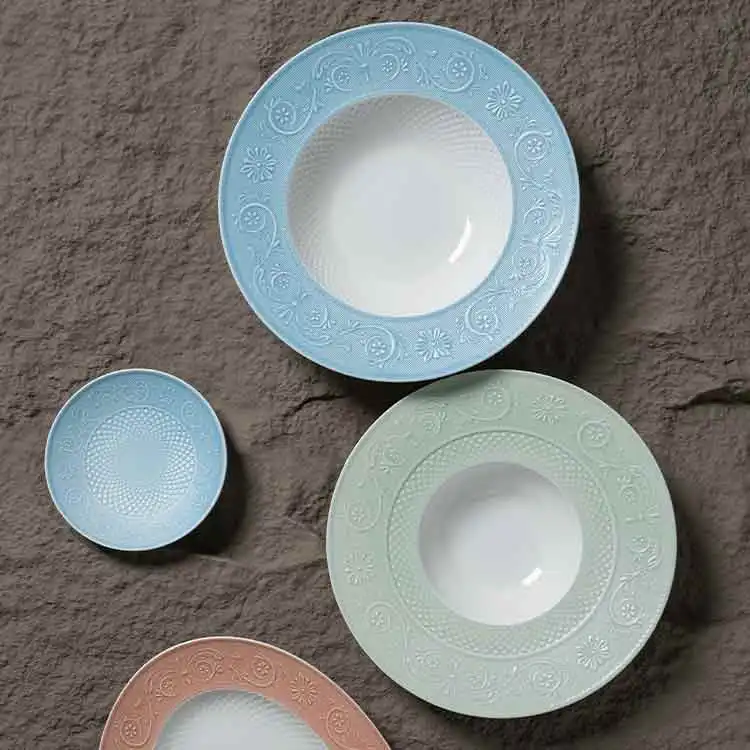
Bone china is formulated with at least 30% calcined bone ash (calcium phosphate). The bone ash shifts the body’s refractive index, producing a warm translucency and creamy white tone that contrasts with the stark blue-white of feldspathic porcelain. Michelin-level and fine dining chefs rely on that subtle warmth to make natural ingredient colors pop.
Bone china also casts into thinner cross-sections while keeping high flexural strength. Ultra-thin lightweight rims don’t interfere with how diners handle food, and the tactile feel is more refined.
Fine Porcelain: Better for Banquet Duty
Fine porcelain (also called hard porcelain or royal white porcelain) uses kaolin, quartz, and feldspar without bone ash. The body is denser and harder.
Banquet settings have practical demands: plates stacked high on mobile racks, aggressive chemical detergents, transport through busy corridors. Fine porcelain offers higher compressive strength and edge hardness. Greater density means better thermal mass—food stays hot longer during extended banquet service—and the rigid structure resists stacking pressure.
When comparing bone china vs. fine porcelain, don’t just look at unit price. Factor breakage rates into the real TCO. Bone china has good thermal shock resistance but lower compressive strength. If your banquet hall gets a lot of physical knocks, fine porcelain costs less to replace over 36 months.
For properties that need bone china in high-traffic areas to convey luxury, consider increasing rim thickness from 3mm to 4mm during customization. This reinforces the most vulnerable impact zone without noticeably sacrificing translucency.
Scene Matching: Shape and Operations Have to Align
Material selection is half the job. The physical geometry—shape, weight distribution, rim profile—has to match the operational scene. When plate design doesn’t fit venue reality, functional failures show up immediately.
Fine Dining Plates: Plating Is the Priority
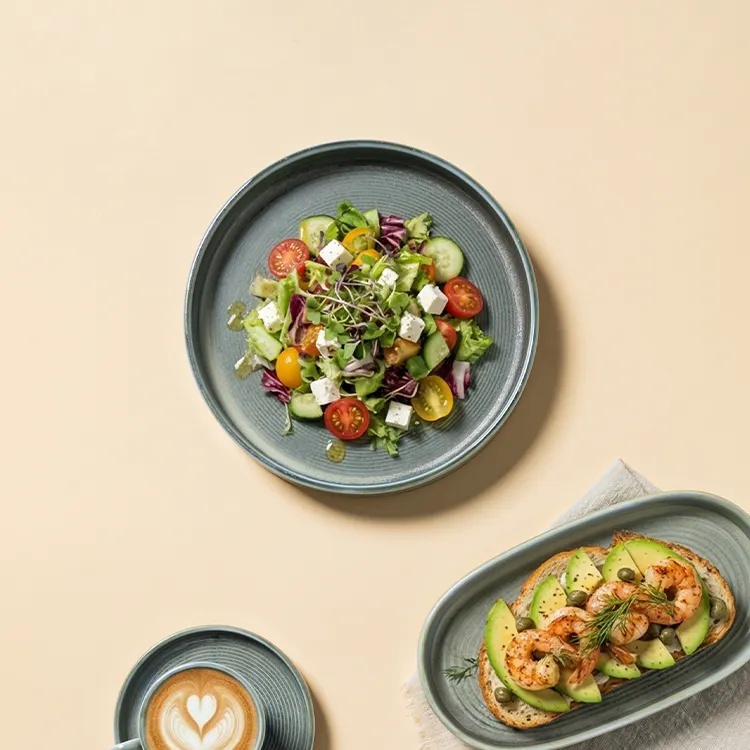
In fine dining, the plate is the canvas. Geometry dictates what the chef can do with plating. Rim width, center well depth, and weight balance are the key parameters.
A wide flat rim gives sauces and purees a physical boundary, so they don’t migrate to the edge where diners grip the plate. Center well depth needs to be precise and consistent—enough volume for protein and garnish without crowding. Weight distribution should be centered. Rim-heavy plates feel unbalanced and cheap when lifted. Center-heavy plates feel solid.
Bulk Procurement for New Hotels: Batch Consistency Is the Real Risk
For new hotels or major F&B renovations, procurement logistics matter as much as the product. When you order tens of thousands of pieces, the biggest risk is batch variation. Kiln temperature fluctuations between production runs cause glaze color and dimensional shifts. A 2mm plate diameter difference can jam automated dishwashing conveyors and wreck the visual symmetry of a set banquet table.
Find a porcelain dinnerware manufacturer with strict automated kiln controls and dimensional QC protocols. This one is non-negotiable.
The industry commonly uses a “core + accent” strategy: standardize core operational shapes (round plates, soup bowls) in durable, cost-effective fine porcelain. Reserve customized bone china or complex geometric pieces for guest-facing, high-margin touchpoints—signature restaurants, VIP suites, executive lounges. Capital expenditure stays optimized, and luxury perception lands where it counts.
Quality, Compliance, and Customization: The Final Gate
After selecting dinnerware, verify safety compliance, commercial cleaning durability, and brand visual accuracy.
FDA and LFGB Certification: Food Safety Is a Baseline
Ceramic glaze is a layer of glass fused to the clay body. Unstable formulations or incomplete firing can cause lead and cadmium—used as fluxes—to leach into acidic food. Mandate that all specified dinnerware meets FDA and LFGB standards. Both tests submerge ceramics in 4% acetic acid for 24 hours and measure heavy metal migration in ppm. These certifications mean the glaze matrix is fully stable and inert—consumers are protected, and the hotel doesn’t carry legal exposure.
Microwave and Dishwasher Safe
In commercial use, tableware goes through scraping, high-temperature chemical washing, rapid air drying, and microwave reheating every day. Glaze Mohs hardness of 6+ prevents silverware from leaving permanent metal marks and resists etching from alkaline dishwasher detergents. The body needs high thermal shock resistance—transitioning from 2°C cold storage directly into a 70°C dishwasher without structural failure.
OEM/ODM Customization: Four Steps
Tableware has to extend the hotel’s brand physically. That requires a manufacturing partner who can execute high-precision customization without compromising structural integrity. PITO’s four-step OEM/ODM process:
- 3D prototyping and mold engineering: 2D sketches converted to 3D CAD models, high-density resin master molds machined, ensuring plaster production molds capture exact dimensional tolerances and rim profiles.
- Glaze and decal formulation: Custom colors get specific glaze recipes from chemical engineers. Branding uses decal technology with ceramic inks matched to Pantone references from the brand.
- High-temperature firing and application: Decals applied as underglaze (fired at 1280°C, design fully abrasion-resistant) or overglaze (fired at 800°C, allowing detailed, metallic, or matte effects).
- Optical and dimensional QC: Every piece undergoes automated optical inspection for glaze defects, then manual checks for logo centering and alignment.
Frequently Asked Questions
Can plates with custom logos or gold rims go in a commercial microwave?
Underglaze or in-glaze custom logos (pattern fused beneath the glaze surface) are safe for microwave use. Gold, silver, or platinum rim decorations (typically overglaze) must never go in a microwave—they cause arcing and damage the tableware. For items that need frequent microwave reheating, explicitly request “no metallic decorations” or “pure underglaze customization” from the supplier.
Grey marks or black scratches after multiple dishwasher cycles—is that a quality defect?
Not a porcelain defect. Metal marking from stainless steel cutlery, or limescale from hard water. Write Mohs hardness 6+ into the spec during procurement and scratch adhesion drops significantly. For removal, have the dishwashing team do a weekly deep clean with commercial porcelain conditioner or mild acidic cleaner. It comes off easily.
Stacking different-sized plates—rim wear or plates getting stuck?
Limited storage in high-traffic hotels means stacking is daily reality. Fine porcelain has high compressive strength, but prolonged hard friction still causes microscopic glaze wear over time. Pick shapes with stackability grooves or anti-slip foot rings. For bone china and lighter pieces, slip non-woven interleaving paper or silicone pads between stacks. Costs almost nothing, extends lifespan noticeably.
Custom hotel logo dinnerware, small initial batch for menu testing or VIP rooms—what MOQ?
“In-stock white body + overglaze decal (logo)” needs no new molds, so MOQ can drop to 100-300 pieces per design. Good for menu testing or small-scale trials. Completely unique shapes requiring 3D mold creation or complex underglaze/in-glaze processes have MOQs of 1,000-3,000 pieces per design due to mold fabrication and kiln calibration costs. Discuss phased procurement with the supplier early on.
A few pieces with slightly chipped rims during inventory—still usable for guests?
No. The rough fractured edge flakes further during washing—fragments in food are a safety hazard. Broken glaze absorbs pigments and bacteria that dishwashers can’t fully remove. Log it as breakage, replace from the free spare allowance (typically 2-3% of order volume) in the procurement contract. Served tableware has to be 100% intact.
Conclusion
Tableware selection isn’t an aesthetics question. It’s a calculation based on material parameters and operational logistics. Vitrification rate, compressive strength, thermal shock resistance, compliance standards—these numbers determine how long plates last, how many break, and how much you spend replacing them.
PITO is a professional commercial tableware supplier with the material engineering and scalable manufacturing foundation for hospitality porcelain. For material evaluations, OEM/ODM details, or internationally certified samples, contact the technical team.


LET'S TALK TOGETHER
Lorem ipsum dolor sit amet, consectetur estor adipi isicing elit, sed do eiusmod tempor este uterre incididui unt ut
