




PITO Article
What Is Porcelain Made Of
Porcelain is one of humanity’s most refined material achievements—revered for its combination of strength, beauty, and timeless elegance. But what exactly gives porcelain its uniquely delicate translucency and durable hardness? Let’s break down what porcelain is made of, how it’s crafted, and why it continues to capture global admiration centuries after its invention.
A Brief History of Porcelain
Porcelain originated in ancient China, with the earliest forms appearing as far back as the Tang dynasty (618–907 CE). By the Yuan dynasty (1279–1368), the iconic translucent white material known as true porcelain had been perfected using a mixture of kaolin and petuntse (china stone). European fascination with porcelain began in the 14th century via Marco Polo, but it wasn’t until the 18th century that true hard-paste porcelain was successfully replicated in the West, most notably in Meissen, Germany.
Types of Porcelain
There are three main types of porcelain, each with slight variations in composition and firing techniques:
1. Hard-Paste Porcelain (True Porcelain)
- Composition: Kaolin + Feldspar + Quartz
- Firing Temperature: ~1,450 °C (2,650 °F)
- Characteristics: Strong, durable, white, slightly translucent
- Used in: Fine tableware, decorative art, and premium ceramics
2. Soft-Paste Porcelain (Artificial Porcelain)
- Composition: Clay + Ground Glass or Flux
- Firing Temperature: ~1,200 °C (2,200 °F)
- Characteristics: Softer body, can be cut with a file, more porous
- Notable Origins: 17th–18th century France (e.g. Sèvres Manufactory)
3. Bone China
- Composition: Kaolin + Feldspar + Bone Ash (up to 50%)
- Firing Temperature: ~1,200–1,250 °C
- Characteristics: Lightweight, strong, highly translucent
- Origin: England, mid-18th century
What Is Porcelain Made Of
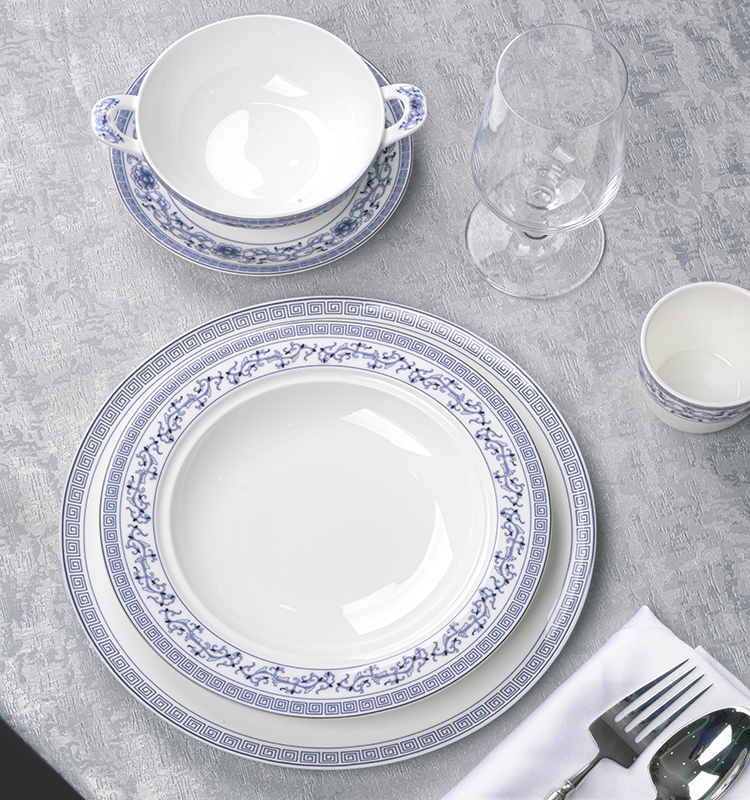
The beauty and resilience of porcelain come from its carefully balanced ingredients. Each plays a vital role in the final product:
Kaolin (China Clay)
A rare white clay that gives porcelain its plasticity, whiteness, and structure. It is the essential binding agent and forms the porcelain body.
Feldspar
One of the most abundant minerals on Earth, feldspar lowers the melting point of the mix and acts as a flux, helping the porcelain vitrify during firing. It also contributes to strength and surface gloss.
Quartz (or Flint)
Quartz improves thermal stability and helps give porcelain its hardness and rigidity. Its fine grains aid in creating a smooth finish and prevent warping during firing.
Bone Ash (in Bone China)
Derived from animal bones, this ingredient adds a unique blend of strength and translucency to bone china, making it ideal for luxury tableware.
The Porcelain-Making Process
Porcelain is not just about mixing ingredients—it’s a fusion of art and science. Here’s how it’s made:
- Raw materials (kaolin, feldspar, quartz) are crushed and ground into a fine powder.
- Water is added to create a workable clay or slip for casting.
2. Forming
- Shaping is done by hand, in moulds, or on a potter’s wheel.
- Handles, spouts, and fine details are added separately and joined carefully.
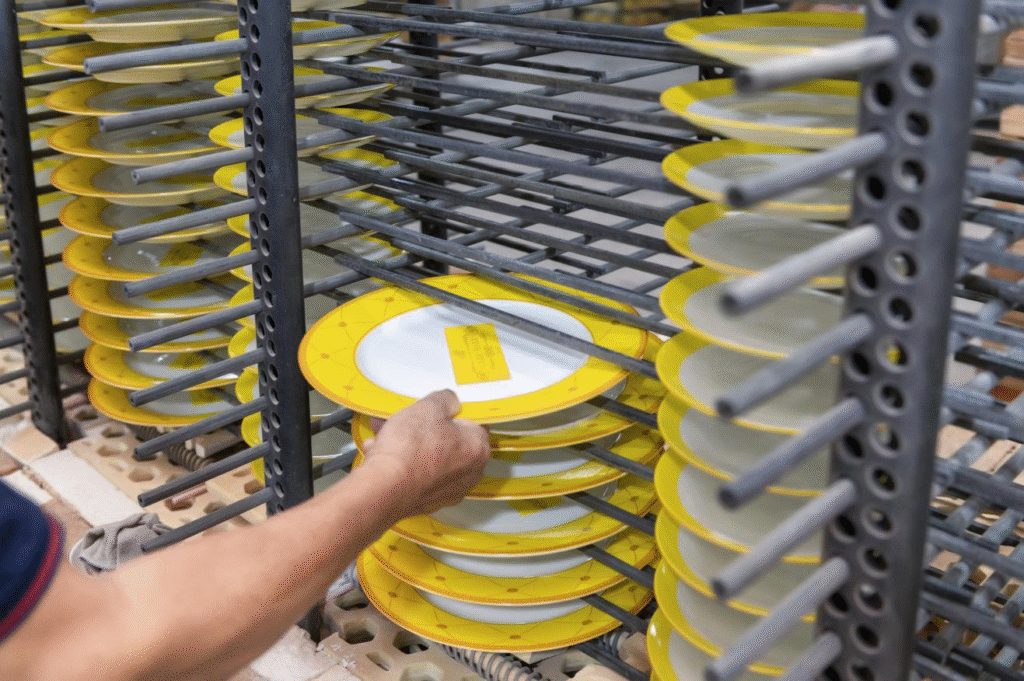
3. Bisque Firing (First Firing)
- The shaped piece is fired at around 1300-1320 ℃.
- By reducing the water absorption of the ceramic body, it prevents the glaze from being absorbed too quickly during application, avoiding uneven surfaces or bubbles.
- At the same time, it allows internal moisture to fully evaporate, effectively minimizing cracking and deformation during the second firing.
4. Glaze firing (Second Firing)
- Glaze firing temperature of 1280℃.
- During the glaze firing process, the glaze melts at high temperatures and evenly coats the surface of the ceramic body. Upon cooling, it forms a translucent glassy layer that not only enhances the ceramic’s elegant appearance but also provides a smooth, jade-like touch.
- The glaze effectively seals the capillary pores of the body, reducing water absorption, while also improving overall mechanical strength and hardness—combining both beauty and functionality.
5. Decoration
- Porcelain can be hand-painted, apploque, or painting the gold.
- Decals are divided into underglaze decals – decals applied on Adob; Glazed decals – Applying patterns after the unglazed body is fired. On-glaze decals – Applique after glaze firing.
6. Decal Firing (Third Firing)
According to decal temperature adjust the Decal firing temperature by computer (on-glaze temperature is 700-900 °)
Why Is Porcelain So Special
Porcelain’s enduring popularity isn’t just about beauty—it’s built to last.
Key Benefits of Porcelain:
- Extremely Strong: Despite its thinness, porcelain is incredibly durable.
- Non-Porous: Hygienic and stain-resistant, ideal for kitchens and bathrooms.
- Heat Resistant: Perfect for high-heat environments like ovens and kilns.
- Scratch-Resistant: Especially when glazed properly.
- Lightweight & Elegant: Combines functionality with refined aesthetics.
From ancient imperial dynasties to modern homes and restaurants, porcelain remains a material of prestige and practicality.
Conclusion: More Than Just Clay
Porcelain is a masterpiece of material science and artistry, made from humble earth elements that transform—under the hands of skilled artisans and extreme heat—into delicate, gleaming works of functional beauty. Whether you’re handling a minimalist mug or admiring a hand-painted Ming vase, you’re engaging with a legacy that spans continents and millennia.


LET'S TALK TOGETHER
Lorem ipsum dolor sit amet, consectetur estor adipi isicing elit, sed do eiusmod tempor este uterre incididui unt ut
